AI researchers describe state-of-the-art models as one thing repeated at scale: the Transformer, wired identically for text, pixels, or speech. Neuroscientists describe the cortex as a mosaic - dense Layer 4 in visual cortex for spatial encoding, thick Layers 5/6 in motion cortex for temporal integration - different jobs solved by different structures. This paper argues the gap is a structural error, not a stylistic one, and is measurable. A century of cytoarchitecture, from Brodmann to single-cell Patch-seq, shows distinct cognitive functions are implemented by qualitatively different structures, not by rescaling one template. The convolutional neural network is the field's own proof: local receptive fields and hierarchical depth encoded this prior directly, reaching strong image recognition on far less data than later architectures needed. The paper traces how this lesson was discarded: the "Hardware Lottery" made the Transformer the path of least resistance, not the principled choice, and Mixture-of-Experts, often cited as diversity, in fact partitions parameters among identical experts. A functionalist analysis shows the Transformer is best understood as a functional analog of the hippocampal formation, not a general-purpose cortex - the same mistake as treating cortex as one giant Broca's area, except the field has now standardized on a giant hippocampus, applied to tasks it was never built for: audition, executive gating, working memory. The paper closes with an alternative: a Heterogeneous Topological Network, a System of Systems in which distinct modules keep the inductive bias their computation demands and communicate through standardized interfaces. This is a design discipline for AI architects, not cognitive science: specify modularity before training, using structural evidence as a design input rather than reverse-engineering architecture from a trained model's behavior.
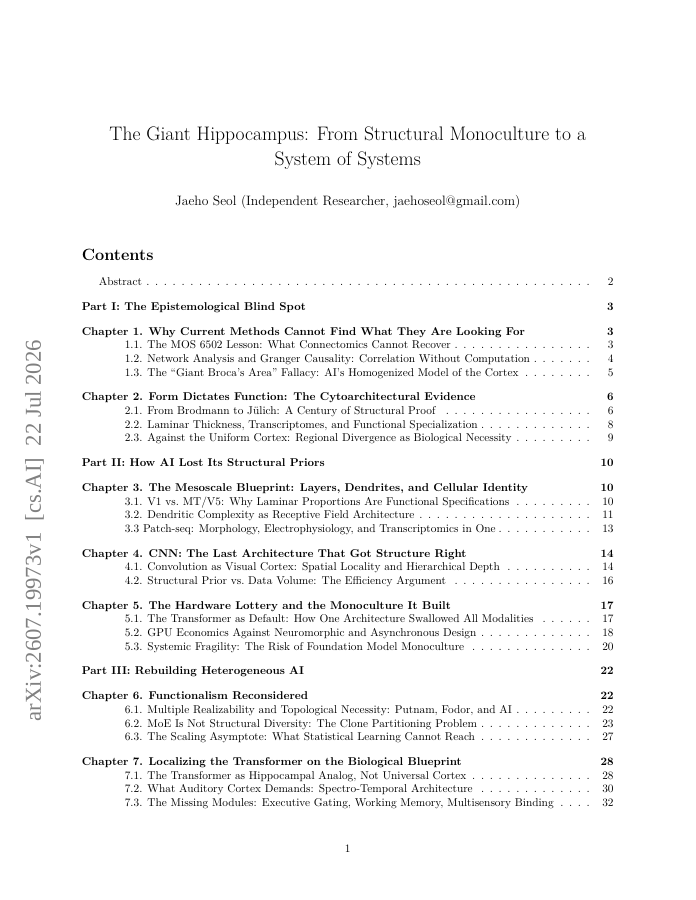
The Giant Hippocampus: From Structural Monoculture to a System of Systems
AI researchers describe state-of-the-art models as one thing repeated at scale: the Transformer, wired identically for text, pixels, or speech. Neuroscientists describe the cortex as a mosaic - dense Layer 4 in visual cortex for spatial encoding, thick Layers 5/6 in motion…
- Preview
- Year
- 2026
- Hosting
- Abstract onlyARXIV-DEFAULT
Cite
Notes
Only stored in your browser.
Attribution
- Abstract & full text
- arxiv.org/abs/2607.19973ARXIV-DEFAULT
- TL;DR
- Semantic Scholar