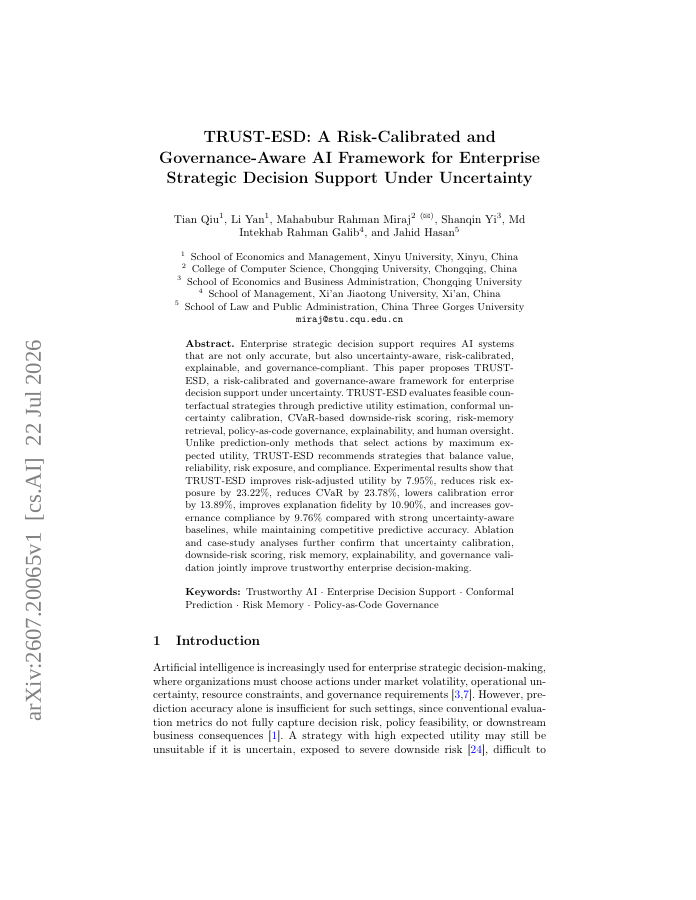
Enterprise strategic decision support requires AI systems that are not only accurate, but also uncertainty-aware, risk-calibrated, explainable, and governance-compliant. This paper proposes TRUST-ESD, a risk-calibrated and governance-aware framework for enterprise decision support under uncertainty. TRUST-ESD evaluates feasible counterfactual strategies through predictive utility estimation, conformal uncertainty calibration, CVaR-based downside-risk scoring, risk-memory retrieval, policy-as-code governance, explainability, and human oversight. Unlike prediction-only methods that select actions by maximum expected utility, TRUST-ESD recommends strategies that balance value, reliability, risk exposure, and compliance. Experimental results show that TRUST-ESD improves risk-adjusted utility by 7.95%, reduces risk exposure by 23.22%, reduces CVaR by 23.78%, lowers calibration error by 13.89%, improves explanation fidelity by 10.90%, and increases governance compliance by 9.76% compared with strong uncertainty-aware baselines, while maintaining competitive predictive accuracy. Ablation and case-study analyses further confirm that uncertainty calibration, downside-risk scoring, risk memory, explainability, and governance validation jointly improve trustworthy enterprise decision-making.
TRUST-ESD: A Risk-Calibrated and Governance-Aware AI Framework for Enterprise Strategic Decision Support Under Uncertainty
Enterprise strategic decision support requires AI systems that are not only accurate, but also uncertainty-aware, risk-calibrated, explainable, and governance-compliant.
- Preview
- Year
- 2026
- Hosting
- Full text hostedCC-BY-4.0
Cite
Notes
Only stored in your browser.
Attribution
- Abstract & full text
- arxiv.org/abs/2607.20065CC-BY-4.0
- TL;DR
- Semantic Scholar