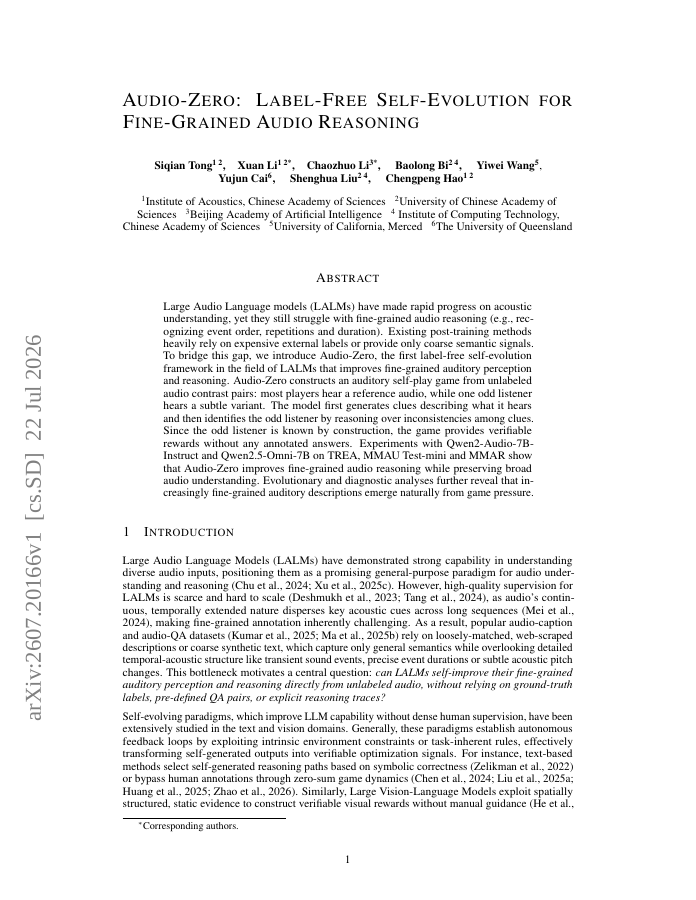
Large Audio Language models (LALMs) have made rapid progress on acoustic understanding, yet they still struggle with fine-grained audio reasoning (e.g., recognizing event order, repetitions and duration). Existing post-training methods heavily rely on expensive external labels or provide only coarse semantic signals. To bridge this gap, we introduce Audio-Zero, the first label-free self-evolution framework in the field of LALMs that improves fine-grained auditory perception and reasoning. Audio-Zero constructs an auditory self-play game from unlabeled audio contrast pairs: most players hear a reference audio, while one odd listener hears a subtle variant. The model first generates clues describing what it hears and then identifies the odd listener by reasoning over inconsistencies among clues. Since the odd listener is known by construction, the game provides verifiable rewards without any annotated answers. Experiments with Qwen2-Audio-7B-Instruct and Qwen2.5-Omni-7B on TREA, MMAU Test-mini and MMAR show that Audio-Zero improves fine-grained audio reasoning while preserving broad audio understanding. Evolutionary and diagnostic analyses further reveal that increasingly fine-grained auditory descriptions emerge naturally from game pressure.
Audio-Zero: Label-Free Self-Evolution for Fine-Grained Audio Reasoning
Large Audio Language models (LALMs) have made rapid progress on acoustic understanding, yet they still struggle with fine-grained audio reasoning (e.g., recognizing event order, repetitions and duration).
- Preview
- Year
- 2026
- Hosting
- Abstract onlyARXIV-DEFAULT
Cite
Notes
Only stored in your browser.
Attribution
- Abstract & full text
- arxiv.org/abs/2607.20166ARXIV-DEFAULT
- TL;DR
- Semantic Scholar