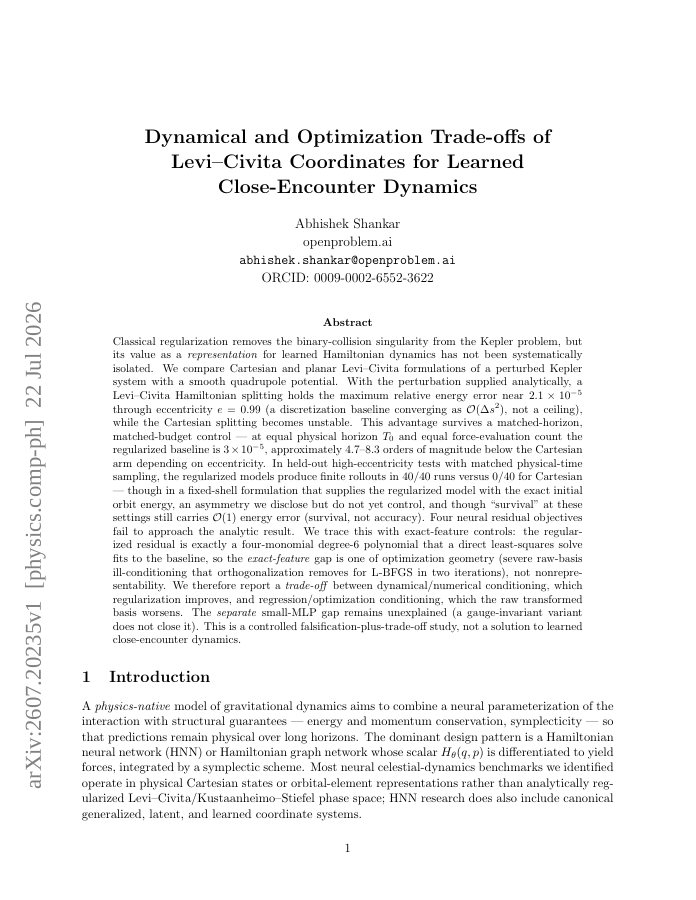
Classical regularization removes the binary-collision singularity from the Kepler problem, but its value as a representation for learned Hamiltonian dynamics has not been systematically isolated. We compare Cartesian and planar Levi--Civita formulations of a perturbed Kepler system with a smooth quadrupole potential. With the perturbation supplied analytically, a Levi--Civita Hamiltonian splitting holds the maximum relative energy error near 2.1\times10^{-5} through eccentricity e=0.99, while the Cartesian splitting becomes unstable. This advantage persists at matched physical horizon and force-evaluation budget, where the regularized baseline is 3\times10^{-5}, about 4.7--8.3 orders of magnitude below the Cartesian arm depending on eccentricity. In held-out high-eccentricity tests with matched sampling, regularized models produce finite rollouts in 40/40 runs versus 0/40 for Cartesian. However, the fixed-shell construction supplies the regularized model with the exact initial orbit energy, and survival still carries O(1) energy error. Four neural residual objectives fail to approach the analytic result. Exact-feature controls show that the regularized residual is a four-monomial degree-6 polynomial that a direct least-squares solve fits to the baseline. The remaining exact-feature gap is due to severe raw-basis ill-conditioning: orthogonalization restores baseline fitting for L-BFGS in two iterations. Small MLPs remain at O(1) rollout error even after gauge symmetrization. Levi--Civita coordinates therefore improve dynamical conditioning while worsening raw-basis optimization conditioning; accurate neural residual learning remains unresolved. This is a controlled falsification-plus-trade-off study, not a solution to learned close-encounter dynamics.
Dynamical and Optimization Trade-offs of Levi--Civita Coordinates for Learned Close-Encounter Dynamics
Classical regularization removes the binary-collision singularity from the Kepler problem, but its value as a representation for learned Hamiltonian dynamics has not been systematically isolated.
- Preview
- Year
- 2026
- Hosting
- Abstract onlyARXIV-DEFAULT
Cite
Notes
Only stored in your browser.
Attribution
- Abstract & full text
- arxiv.org/abs/2607.20235ARXIV-DEFAULT
- TL;DR
- Semantic Scholar