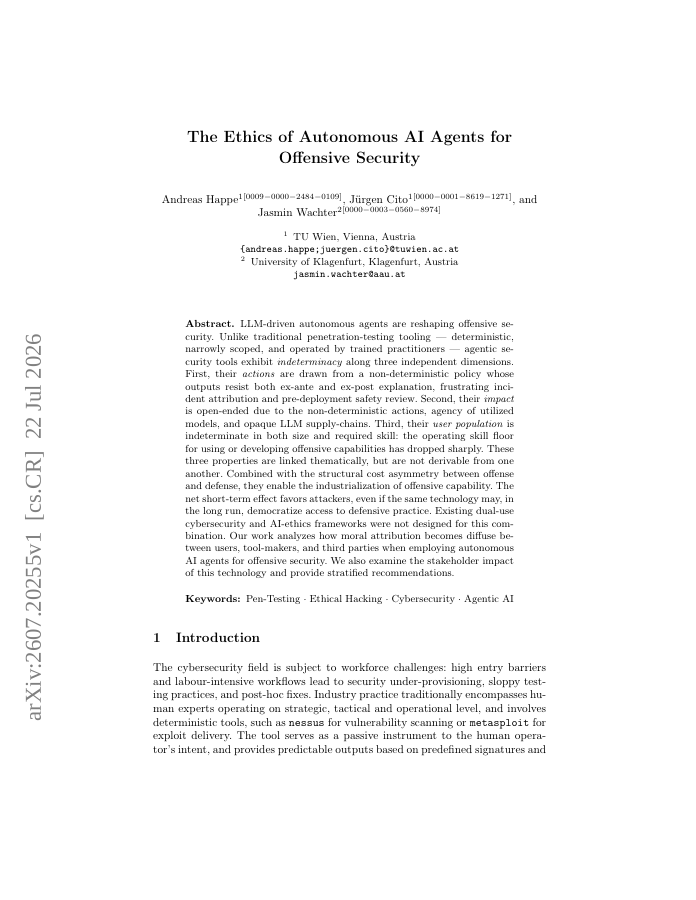
LLM-driven autonomous agents are reshaping offensive security. Unlike traditional penetration-testing tooling -- deterministic, narrowly scoped, and operated by trained practitioners -- agentic security tools exhibit indeterminacy along three independent dimensions. First, their actions are drawn from a non-deterministic policy whose outputs resist both ex-ante and ex-post explanation, frustrating incident attribution and pre-deployment safety review. Second, their impact is open-ended due to the non-deterministic actions, agency of utilized models, and opaque LLM supply-chains. Third, their user population is indeterminate in both size and required skill: the operating skill floor for using or developing offensive capabilities has dropped sharply. These three properties are linked thematically, but are not derivable from one another. Combined with the structural cost asymmetry between offense and defense, they enable the industrialization of offensive capability. The net short-term effect favors attackers, even if the same technology may, in the long run, democratize access to defensive practice. Existing dual-use cybersecurity and AI-ethics frameworks were not designed for this combination. Our work analyzes how moral attribution becomes diffuse between users, tool-makers, and third parties when employing autonomous AI agents for offensive security. We also examine the stakeholder impact of this technology and provide stratified recommendations.
The Ethics of Autonomous AI Agents for Offensive Security
LLM-driven autonomous agents are reshaping offensive security. Unlike traditional penetration-testing tooling -- deterministic, narrowly scoped, and operated by trained practitioners -- agentic security tools exhibit \textit{indeterminacy} along three independent dimensions.
- Preview
- Year
- 2026
- Hosting
- Full text hostedCC-BY-4.0
Cite
Notes
Only stored in your browser.
Attribution
- Abstract & full text
- arxiv.org/abs/2607.20255CC-BY-4.0
- TL;DR
- Semantic Scholar