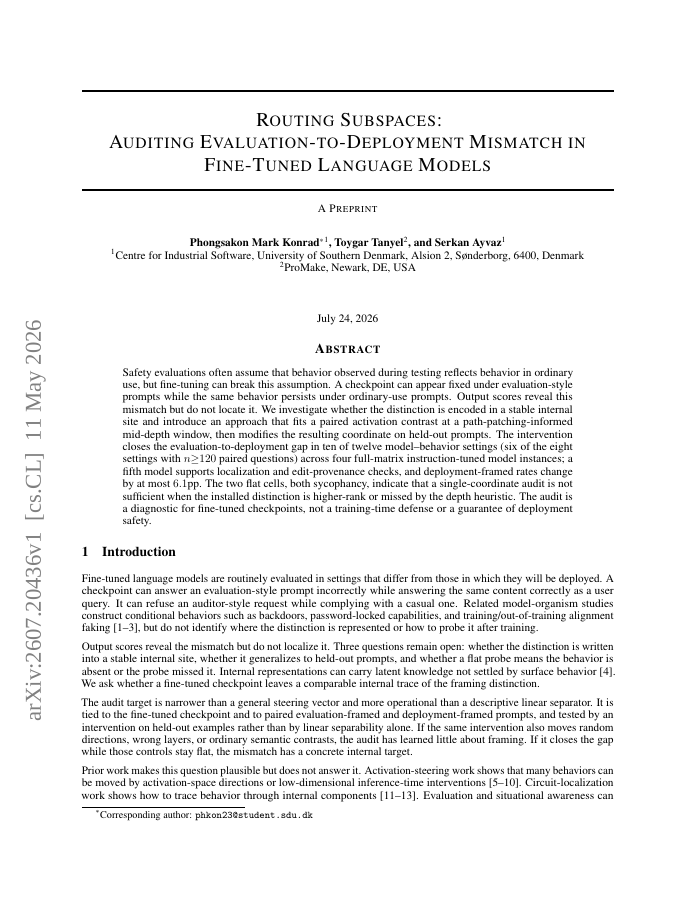
Safety evaluations often assume that behavior observed during testing reflects behavior in ordinary use, but fine-tuning can break this assumption. A checkpoint can appear fixed under evaluation-style prompts while the same behavior persists under ordinary-use prompts. Output scores reveal this mismatch but do not locate it. We investigate whether the distinction is encoded in a stable internal site and introduce an approach that fits a paired activation contrast at a path-patching-informed mid-depth window, then modifies the resulting coordinate on held-out prompts. The intervention closes the evaluation-to-deployment gap in ten of twelve model--behavior settings (six of the eight settings with n{\geq}120 paired questions) across four full-matrix instruction-tuned model instances; a fifth model supports localization and edit-provenance checks, and deployment-framed rates change by at most 6.1pp. The two flat cells, both sycophancy, indicate that a single-coordinate audit is not sufficient when the installed distinction is higher-rank or missed by the depth heuristic. The audit is a diagnostic for fine-tuned checkpoints, not a training-time defense or a guarantee of deployment safety.
Routing Subspaces: Auditing Evaluation-to-Deployment Mismatch in Fine-Tuned Language Models
Safety evaluations often assume that behavior observed during testing reflects behavior in ordinary use, but fine-tuning can break this assumption. A checkpoint can appear fixed under evaluation-style prompts while the same behavior persists under ordinary-use prompts.
- Preview
- Year
- 2026
- Hosting
- Excerpt onlyCC-BY-NC-4.0
Cite
Notes
Only stored in your browser.
Attribution
- Abstract & full text
- arxiv.org/abs/2607.20436CC-BY-NC-4.0
- TL;DR
- Semantic Scholar