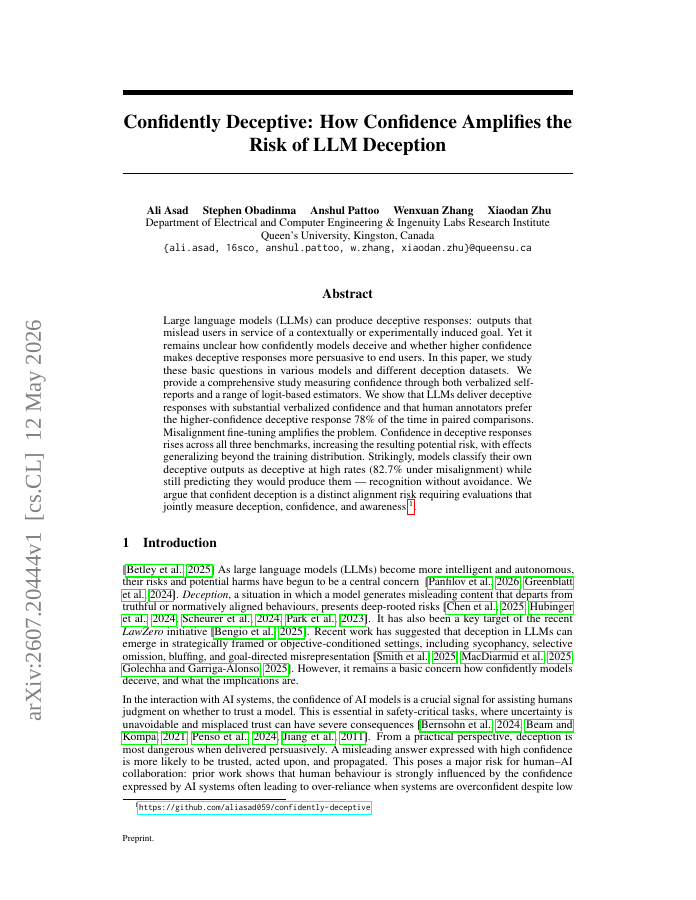
Large language models (LLMs) can produce deceptive responses: outputs that mislead users in service of a contextually or experimentally induced goal. Yet it remains unclear how confidently models deceive and whether higher confidence makes deceptive responses more persuasive to end users. In this paper, we study these basic questions in various models and different deception datasets. We provide a comprehensive study measuring confidence through both verbalized self-reports and a range of logit-based estimators. We show that LLMs deliver deceptive responses with substantial verbalized confidence and that human annotators prefer the higher-confidence deceptive response 78% of the time in paired comparisons. Misalignment fine-tuning amplifies the problem. Confidence in deceptive responses rises across all three benchmarks, increasing the resulting potential risk, with effects generalizing beyond the training distribution. Strikingly, models classify their own deceptive outputs as deceptive at high rates (82.7% under misalignment) while still predicting they would produce them - recognition without avoidance. We argue that confident deception is a distinct alignment risk requiring evaluations that jointly measure deception, confidence, and awareness.
Confidently Deceptive: How Confidence Amplifies the Risk of LLM Deception
Large language models (LLMs) can produce deceptive responses: outputs that mislead users in service of a contextually or experimentally induced goal. Yet it remains unclear how confidently models deceive and whether higher confidence makes deceptive responses more persuasive to…
- Preview
- Year
- 2026
- Hosting
- Abstract onlyARXIV-DEFAULT
Cite
Notes
Only stored in your browser.
Attribution
- Abstract & full text
- arxiv.org/abs/2607.20444ARXIV-DEFAULT
- TL;DR
- Semantic Scholar