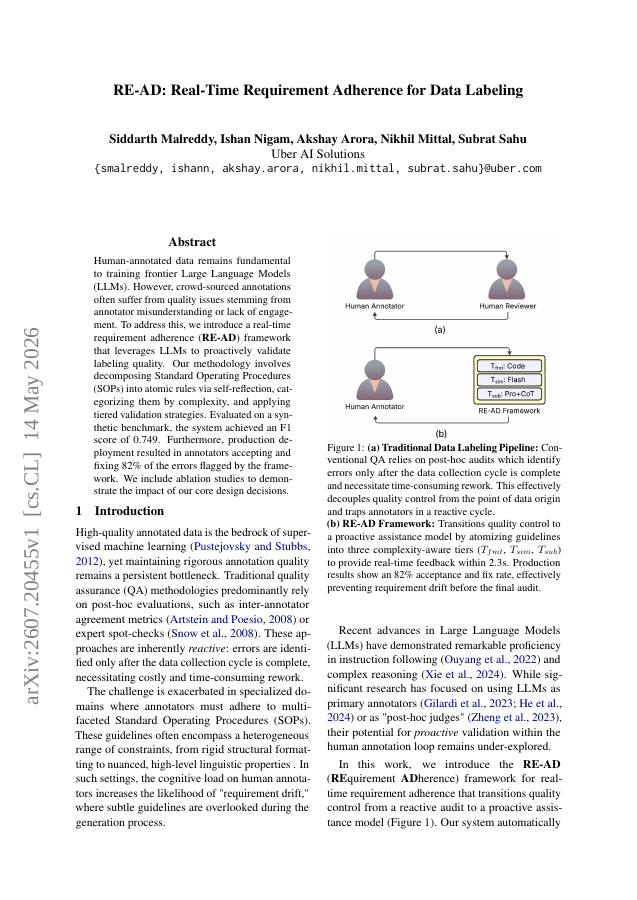
Human-annotated data remains fundamental to training frontier Large Language Models (LLMs). However, crowd-sourced annotations often suffer from quality issues stemming from annotator misunderstanding or lack of engagement. To address this, we introduce a real-time requirement adherence (RE-AD) framework that leverages LLMs to proactively validate labeling quality. Our methodology involves decomposing Standard Operating Procedures (SOPs) into atomic rules via self-reflection, categorizing them by complexity, and applying tiered validation strategies. Evaluated on a synthetic benchmark, the system achieved an F1 score of 0.749. Furthermore, production deployment resulted in annotators accepting and fixing 82% of the errors flagged by the framework. We include ablation studies to demonstrate the impact of our core design decisions.
RE-AD: Real-Time Requirement Adherence for Data Labeling
Human-annotated data remains fundamental to training frontier Large Language Models (LLMs). However, crowd-sourced annotations often suffer from quality issues stemming from annotator misunderstanding or lack of engagement.
- Preview
- Year
- 2026
- Hosting
- Abstract onlyARXIV-DEFAULT
Cite
Notes
Only stored in your browser.
Attribution
- Abstract & full text
- arxiv.org/abs/2607.20455ARXIV-DEFAULT
- TL;DR
- Semantic Scholar