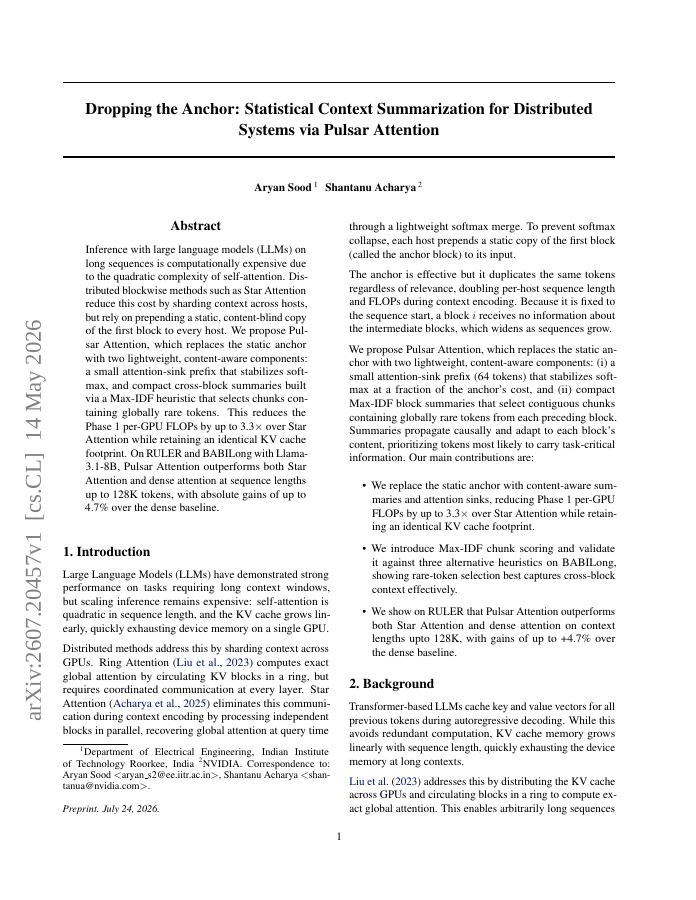
Inference with large language models (LLMs) on long sequences is computationally expensive due to the quadratic complexity of self-attention. Distributed blockwise methods such as Star Attention reduce this cost by sharding context across hosts, but rely on prepending a static, content-blind copy of the first block to every host. We propose Pulsar Attention, which replaces the static anchor with two lightweight, content-aware components: a small attention-sink prefix that stabilizes softmax, and compact cross-block summaries built via a Max-IDF heuristic that selects chunks containing globally rare tokens. This reduces the Phase 1 per-GPU FLOPs by up to 3.3\times over Star Attention while retaining an identical KV cache footprint. On RULER and BABILong with Llama-3.1-8B, Pulsar Attention outperforms both Star Attention and dense attention at sequence lengths up to 128K tokens, with absolute gains of up to 4.7% over the dense baseline.
Dropping the Anchor: Statistical Context Summarization for Distributed Systems via Pulsar Attention
Inference with large language models (LLMs) on long sequences is computationally expensive due to the quadratic complexity of self-attention. Distributed blockwise methods such as Star Attention reduce this cost by sharding context across hosts, but rely on prepending a static,…
- Preview
- Year
- 2026
- Hosting
- Full text hostedCC-BY-4.0
Cite
Notes
Only stored in your browser.
Attribution
- Abstract & full text
- arxiv.org/abs/2607.20457CC-BY-4.0
- TL;DR
- Semantic Scholar