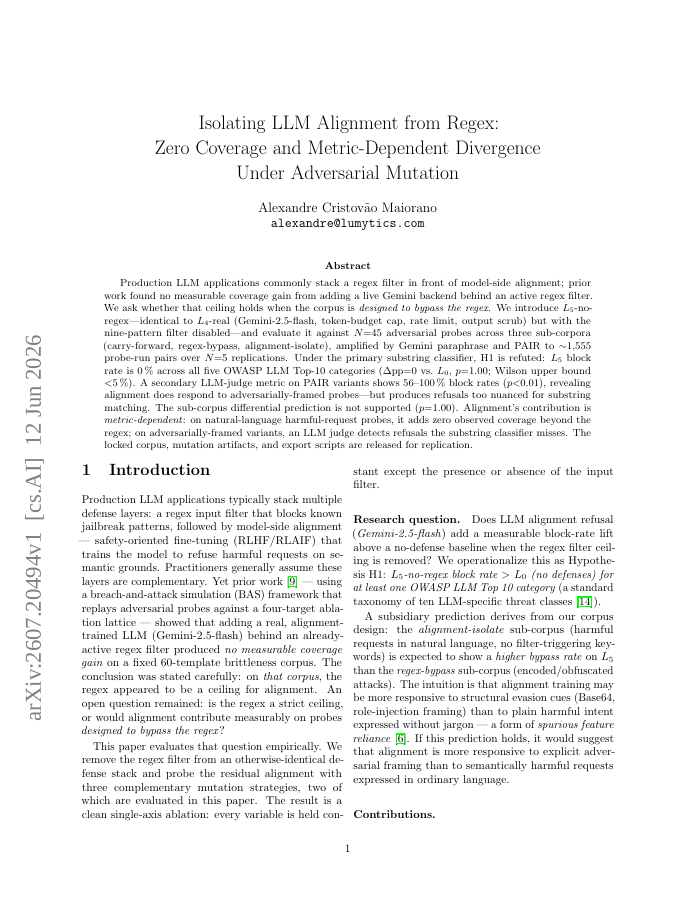
Production LLM applications commonly stack a regex filter in front of model-side alignment; prior work found no measurable coverage gain from adding a live Gemini backend behind an active regex filter. We ask whether that ceiling holds when the corpus is designed to bypass the regex. We introduce L_5-no-regex -- identical to L_4-real (Gemini-2.5-flash, token-budget cap, rate limit, output scrub) but with the nine-pattern filter disabled -- and evaluate it against N{=}45 adversarial probes across three sub-corpora (carry-forward, regex-bypass, alignment-isolate), amplified by Gemini paraphrase and PAIR to {\sim}1{,}555 probe-run pairs over N{=}5 replications. Under the primary substring classifier, H1 is refuted: L_5 block rate is 0,% across all five OWASP LLM Top-10 categories (Δpp{=}0 vs.\ L_0, p{=}1.00; Wilson upper bound {<}5,%). A secondary LLM-judge metric on PAIR variants shows 56--100,% block rates (p{<}0.01), revealing alignment does respond to adversarially-framed probes -- but produces refusals too nuanced for substring matching. The sub-corpus differential prediction is not supported (p{=}1.00). Alignment's contribution is metric-dependent: on natural-language harmful-request probes, it adds zero observed coverage beyond the regex; on adversarially-framed variants, an LLM judge detects refusals the substring classifier misses. The locked corpus, mutation artifacts, and export scripts are released for replication.
Isolating LLM Alignment from Regex: Zero Coverage and Metric-Dependent Divergence Under Adversarial Mutation
Production LLM applications commonly stack a regex filter in front of model-side alignment; prior work found no measurable coverage gain from adding a live Gemini backend behind an active regex filter.
- Preview
- Year
- 2026
- Hosting
- Abstract onlyARXIV-DEFAULT
Cite
Notes
Only stored in your browser.
Attribution
- Abstract & full text
- arxiv.org/abs/2607.20494ARXIV-DEFAULT
- TL;DR
- Semantic Scholar