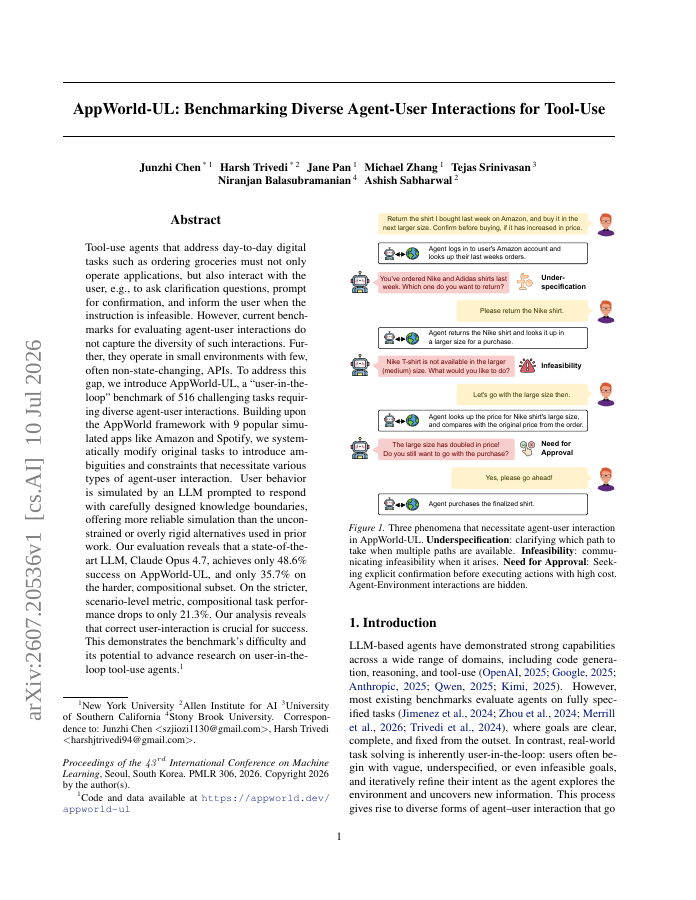
Tool-use agents that address day-to-day digital tasks such as ordering groceries must not only operate applications, but also interact with the user, e.g., to ask clarification questions, prompt for confirmation, and inform the user when the instruction is infeasible. However, current benchmarks for evaluating agent-user interactions do not capture the diversity of such interactions. Further, they operate in small environments with few, often non-state-changing, APIs. To address this gap, we introduce AppWorld-UL, a ``user-in-the-loop'' benchmark of 516 challenging tasks requiring diverse agent-user interactions. Building upon the AppWorld framework with 9 popular simulated apps like Amazon and Spotify, we systematically modify original tasks to introduce ambiguities and constraints that necessitate various types of agent-user interaction. User behavior is simulated by an LLM prompted to respond with carefully designed knowledge boundaries, offering more reliable simulation than the unconstrained or overly rigid alternatives used in prior work. Our evaluation reveals that a state-of-the-art LLM, Claude Opus 4.7, achieves only 48.6% success on AppWorld-UL, and only 35.7% on the harder, compositional subset. On the stricter, scenario-level metric, compositional task performance drops to only 21.3%. Our analysis reveals that correct user-interaction is crucial for success. This demonstrates the benchmark's difficulty and its potential to advance research on user-in-the-loop tool-use agents.
AppWorld-UL: Benchmarking Diverse Agent-User Interactions for Tool-Use
Tool-use agents that address day-to-day digital tasks such as ordering groceries must not only operate applications, but also interact with the user, e.g., to ask clarification questions, prompt for confirmation, and inform the user when the instruction is infeasible.
- Preview
- Year
- 2026
- Hosting
- Full text hostedCC-BY-4.0
Cite
Notes
Only stored in your browser.
Attribution
- Abstract & full text
- arxiv.org/abs/2607.20536CC-BY-4.0
- TL;DR
- Semantic Scholar