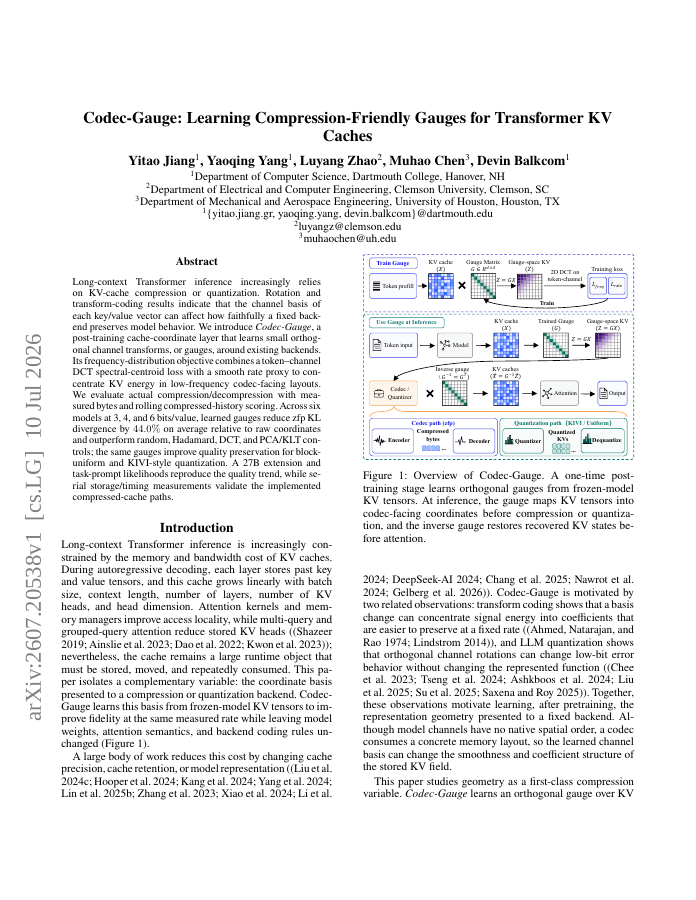
Long-context Transformer inference increasingly relies on KV-cache compression or quantization. Prior rotation and transform-coding results suggest that the channel basis of each key/value vector affects how faithfully a fixed backend preserves model behavior. We introduce Codec-Gauge, a post-training cache-coordinate layer that learns small orthogonal channel transforms around existing compression and quantization backends. Its frequency-distribution objective combines a token-channel DCT spectral-centroid loss with a smooth rate proxy to concentrate KV energy in low-frequency codec-facing layouts. We evaluate actual compression and decompression using measured bytes and rolling compressed-history scoring. Across six models at 3, 4, and 6 bits/value, learned gauges reduce zfp KL divergence by 44.0% on average relative to raw coordinates and outperform random, Hadamard, DCT, and PCA/KLT controls. The same gauges improve quality preservation for block-uniform and KIVI-style quantization. Experiments on a 27B model and long-context task prompts reproduce the quality trend, while serial storage and timing measurements validate the implemented compressed-cache paths. These results establish cache-coordinate geometry as a practical post-training variable for improving compression fidelity without changing model weights, attention semantics, or backend coding rules.
Codec-Gauge: Learning Compression-Friendly Gauges for Transformer KV Caches
Long-context Transformer inference increasingly relies on KV-cache compression or quantization. Prior rotation and transform-coding results suggest that the channel basis of each key/value vector affects how faithfully a fixed backend preserves model behavior.
- Preview
- Year
- 2026
- Hosting
- Full text hostedCC-BY-4.0
Cite
Notes
Only stored in your browser.
Attribution
- Abstract & full text
- arxiv.org/abs/2607.20538CC-BY-4.0
- TL;DR
- Semantic Scholar