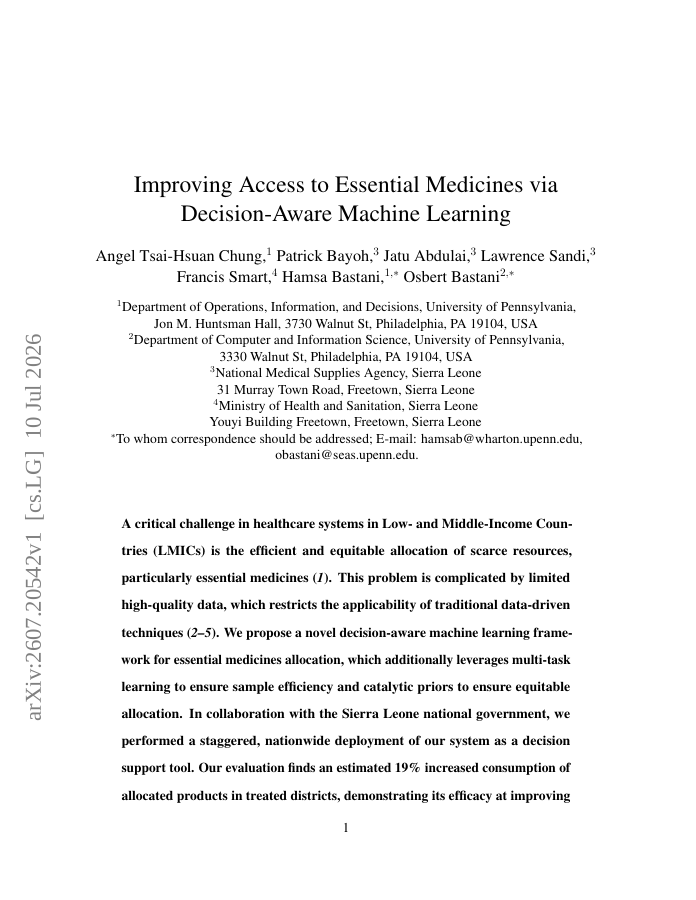
A critical challenge in healthcare systems in low- and middle-income countries (LMICs) is the efficient and equitable allocation of scarce resources, particularly essential medicines. This problem is complicated by limited high-quality data, which restricts the applicability of traditional data-driven techniques. We propose a novel decision-aware machine learning framework for essential medicines allocation, which additionally leverages multi-task learning to ensure sample efficiency and catalytic priors to ensure equitable allocation. In collaboration with the Sierra Leone national government, we performed a staggered, nationwide deployment of our system as a decision support tool. Our econometric evaluation finds an estimated 19% increase in consumption of allocated products in treated districts, demonstrating its efficacy at improving access to essential medicines. Our tool was subsequently scaled nationwide, covering an estimated 2 million women and children under five. Our work demonstrates how machine learning methods can improve efficiency at very low cost in resource-constrained global health settings.
Improving Access to Essential Medicines via Decision-Aware Machine Learning
A critical challenge in healthcare systems in low- and middle-income countries (LMICs) is the efficient and equitable allocation of scarce resources, particularly essential medicines.
- Preview
- Year
- 2026
- Hosting
- Full text hostedCC-BY-4.0
Cite
Notes
Only stored in your browser.
Attribution
- Abstract & full text
- arxiv.org/abs/2607.20542CC-BY-4.0
- TL;DR
- Semantic Scholar