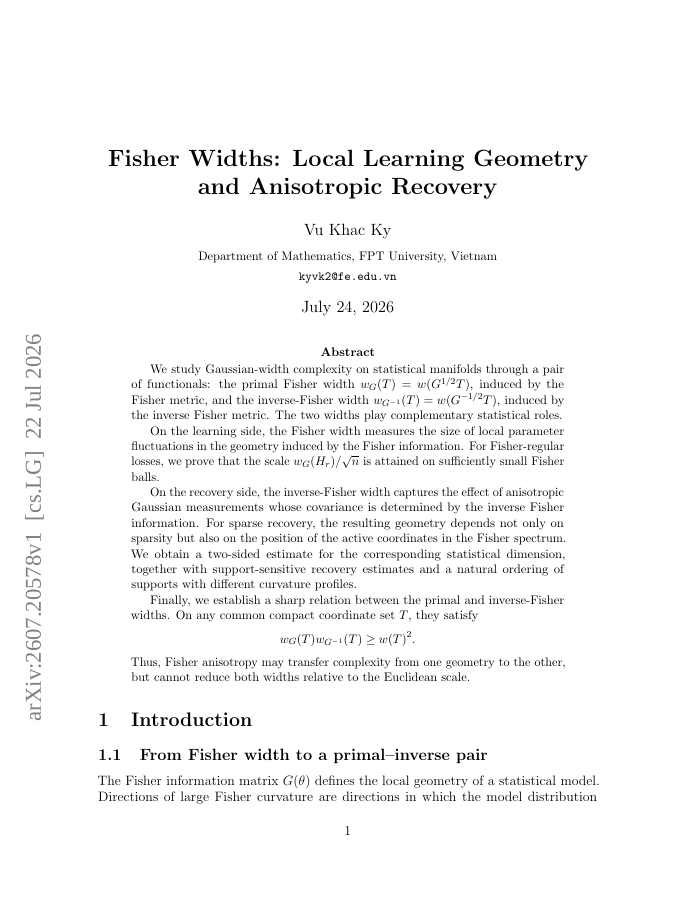
We study Gaussian-width complexity on statistical manifolds through a pair of functionals: the primal Fisher width w_G(T) = w(G^{1/2}T), induced by the Fisher metric, and the inverse-Fisher width w_{G^{-1}}(T) = w(G^{-1/2}T), induced by the inverse Fisher metric. The two widths play complementary statistical roles. On the learning side, the Fisher width measures the size of local parameter fluctuations in the geometry induced by the Fisher information. For Fisher-regular losses, we prove that the scale w_G(H_r)/\sqrt n is attained on sufficiently small Fisher balls. On the recovery side, the inverse-Fisher width captures the effect of anisotropic Gaussian measurements whose covariance is determined by the inverse Fisher information. For sparse recovery, the resulting geometry depends not only on sparsity but also on the position of the active coordinates in the Fisher spectrum. We obtain a two-sided estimate for the corresponding statistical dimension, together with support-sensitive recovery estimates and a natural ordering of supports with different curvature profiles. Finally, we establish a sharp relation between the primal and inverse-Fisher widths. On any common compact coordinate set T, they satisfy [ w_G(T)w_{G^{-1}}(T)\geq w(T)^2. ] Thus, Fisher anisotropy may transfer complexity from one geometry to the other, but cannot reduce both widths relative to the Euclidean scale.
Fisher Widths: Local Learning Geometry and Anisotropic Recovery
We study Gaussian-width complexity on statistical manifolds through a pair of functionals: the primal Fisher width $w_G(T) = w(G^{1/2}T)$, induced by the Fisher metric, and the inverse-Fisher width $w_{G^{-1}}(T) = w(G^{-1/2}T)$, induced by the inverse Fisher metric.
- Preview
- Year
- 2026
- Hosting
- Abstract onlyARXIV-DEFAULT
Cite
Notes
Only stored in your browser.
Attribution
- Abstract & full text
- arxiv.org/abs/2607.20578ARXIV-DEFAULT
- TL;DR
- Semantic Scholar