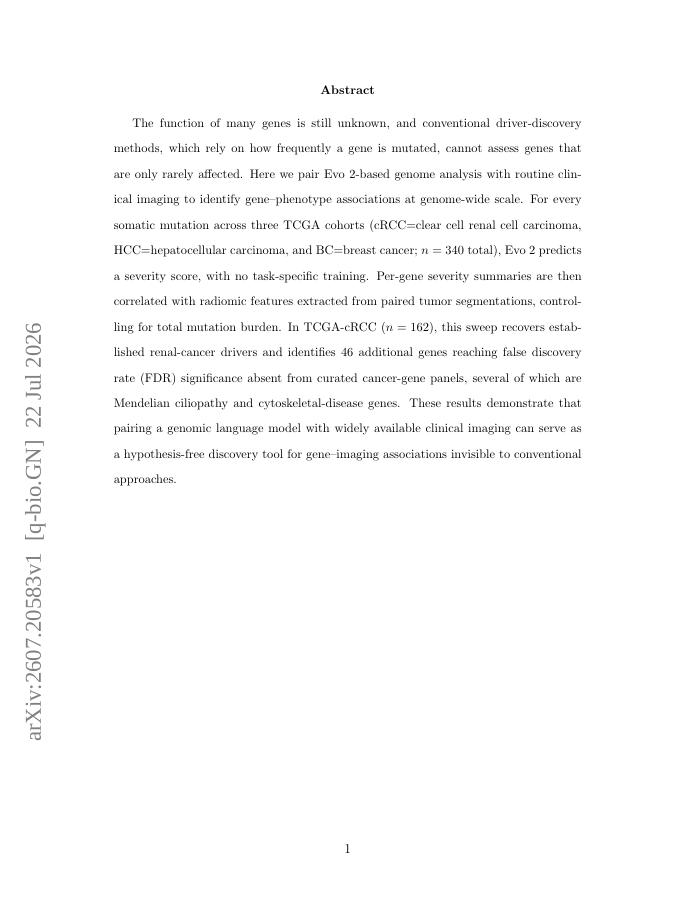
The function of many genes is still unknown, and conventional driver-discovery methods, which rely on how frequently a gene is mutated, cannot assess genes that are only rarely affected. Here we pair Evo 2-based genome analysis with routine clinical imaging to identify gene--phenotype associations at genome-wide scale. For every somatic mutation across three TCGA cohorts (cRCC=clear cell renal cell carcinoma, HCC=hepatocellular carcinoma, and BC=breast cancer; n = 340 total), Evo 2 predicts a severity score, with no task-specific training. Per-gene severity summaries are then correlated with radiomic features extracted from paired tumor segmentations, controlling for total mutation burden. In TCGA-cRCC (n = 162), this sweep recovers established renal-cancer drivers and identifies 46 additional genes reaching false discovery rate (FDR) significance absent from curated cancer-gene panels, several of which are Mendelian ciliopathy and cytoskeletal-disease genes. These results demonstrate that pairing a genomic language model with widely available clinical imaging can serve as a hypothesis-free discovery tool for gene--imaging associations invisible to conventional approaches.
Foundation-model-guided radiogenomic discovery linking cancer genomes to cancer scans
The function of many genes is still unknown, and conventional driver-discovery methods, which rely on how frequently a gene is mutated, cannot assess genes that are only rarely affected.
- Preview
- Year
- 2026
- Hosting
- Full text hostedCC-BY-4.0
Cite
Notes
Only stored in your browser.
Attribution
- Abstract & full text
- arxiv.org/abs/2607.20583CC-BY-4.0
- TL;DR
- Semantic Scholar