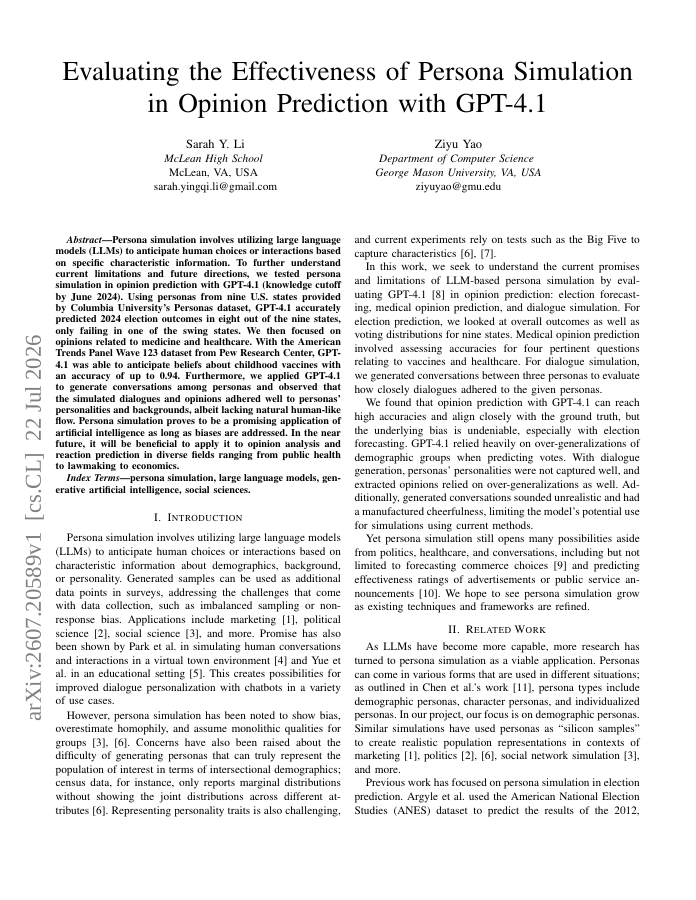
Persona simulation involves utilizing large language models (LLMs) to anticipate human choices or interactions based on specific characteristic information. To further understand current limitations and future directions, we tested persona simulation in opinion prediction with GPT-4.1 (knowledge cutoff by June 2024). Using personas from nine U.S. states provided by Columbia University's Personas dataset, GPT-4.1 accurately predicted 2024 election outcomes in eight out of the nine states, only failing in one of the swing states. We then focused on opinions related to medicine and healthcare. With the American Trends Panel Wave 123 dataset from Pew Research Center, GPT-4.1 was able to anticipate beliefs about childhood vaccines with an accuracy of up to 0.94. Furthermore, we applied GPT-4.1 to generate conversations among personas and observed that the simulated dialogues and opinions adhered well to personas' personalities and backgrounds, albeit lacking natural human-like flow. Persona simulation proves to be a promising application of artificial intelligence as long as biases are addressed. In the near future, it will be beneficial to apply it to opinion analysis and reaction prediction in diverse fields ranging from public health to lawmaking to economics.
Evaluating the Effectiveness of Persona Simulation in Opinion Prediction with GPT-4.1
Persona simulation involves utilizing large language models (LLMs) to anticipate human choices or interactions based on specific characteristic information. To further understand current limitations and future directions, we tested persona simulation in opinion prediction with…
- Preview
- Year
- 2026
- Hosting
- Abstract onlyARXIV-DEFAULT
Cite
Notes
Only stored in your browser.
Attribution
- Abstract & full text
- arxiv.org/abs/2607.20589ARXIV-DEFAULT
- TL;DR
- Semantic Scholar