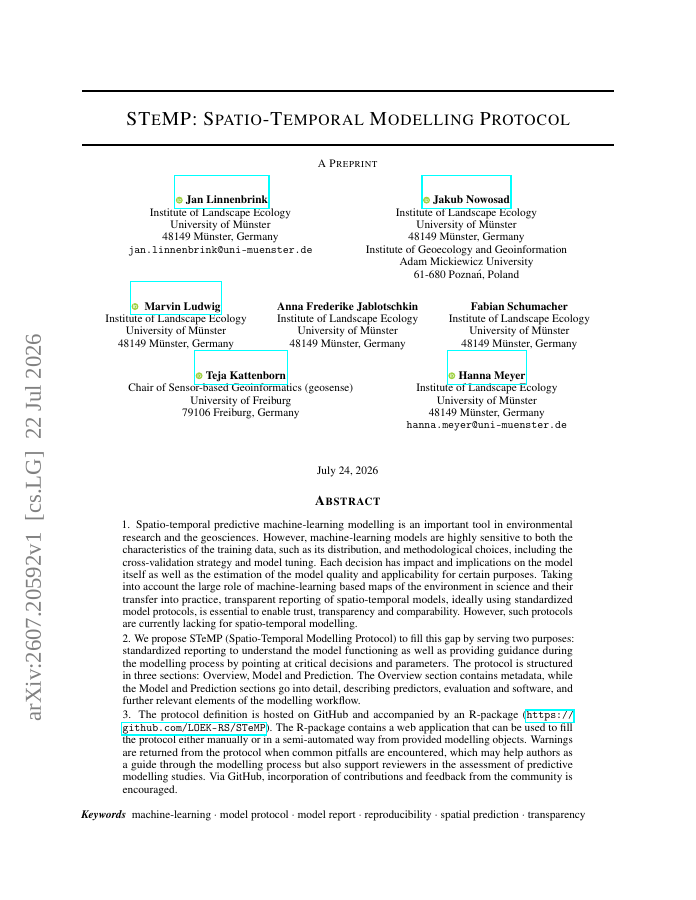
Spatio-temporal machine-learning modelling is an important tool in environmental research. However, machine-learning models are highly sensitive to both the characteristics of the training data, such as its distribution, and methodological choices, including the cross-validation strategy. Each decision has impact and implications on the model itself as well as the estimation of the model quality and applicability for certain purposes. Taking into account the large role of machine-learning based maps of the environment in science and their transfer into practice, transparent reporting of spatio-temporal models, ideally using standardized model protocols, is essential to enable trust, transparency and comparability. However, such protocols are currently lacking for spatio-temporal modelling. We propose STeMP (Spatio-Temporal Modelling Protocol) to fill this gap by serving two purposes: standardized reporting to understand the model functioning as well as providing guidance during the modelling process by pointing at critical decisions and parameters. The protocol is structured in three sections: Overview, Model and Prediction. The Overview section contains metadata, while the Model and Prediction sections go into detail, describing predictors, evaluation and software, and further relevant elements of the modelling workflow. The protocol definition is hosted on GitHub and accompanied by an R-package (https://github.com/LOEK-RS/STeMP). The R-package contains a web application that can be used to fill the protocol either manually or in a semi-automated way from provided modelling objects. Warnings are returned from the protocol when common pitfalls are encountered, which may help authors as a guide through the modelling process but also support reviewers in the assessment of modelling studies. Via GitHub, incorporation of contributions and feedback from the community is encouraged.
STeMP: Spatio-Temporal Modelling Protocol
Spatio-temporal machine-learning modelling is an important tool in environmental research. However, machine-learning models are highly sensitive to both the characteristics of the training data, such as its distribution, and methodological choices, including the cross-validation…
- Preview
- Year
- 2026
- Hosting
- Full text hostedCC-BY-4.0
Cite
Notes
Only stored in your browser.
Attribution
- Abstract & full text
- arxiv.org/abs/2607.20592CC-BY-4.0
- TL;DR
- Semantic Scholar