As humans, we face many decisions that require us to choose between sticking to something and giving up. This thesis uses algorithmic tools to derive insights about such decision-making problems in theoretical models, studying both near-optimal methods and outcomes of social and behavioral influences. Along the way, this thesis sheds light on what we gain and what we lose as we move from a messy and complex real world setting to a very general abstract model by studying various points along this spectrum. In Part I, we study algorithms for sequential decision-making in the improving multi-armed bandits problem. We provide nearly matching upper and lower bounds in the general case. Then, we then ask what is possible if we have access to similar instances to the one we wish to deploy our algorithm on. To that end, we provide guarantees in the data-driven algorithm design framework, showing that a polynomial number of samples is sufficient for learning good algorithms from a class of algorithms. In Part II, we study algorithmic approaches for problems in social epistemology. We start by analyzing what role theoretical models can play in the study of social problems. We then study social and behavioral influences in decision-making requiring investment. First, we provide mathematical formalism in which to study the formation of pessimism traps, a phenomenon identified by philosophers in which agents are influenced by their predecessors to engage in less-ambitious goals. We develop financial interventions to sustainably shift communities out of these traps. The second problem we study is the influence of grit as a behavioral trait in ambitious decision-making. Overall, these works seek to theoretically model phenomena in social epistemology and provide a framework for intervening algorithmically.
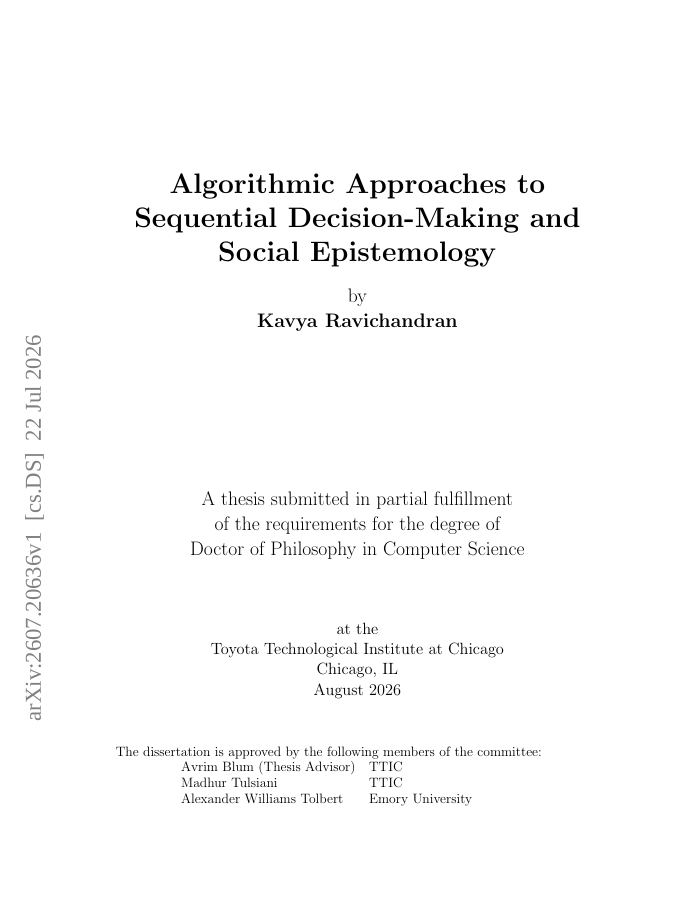
Algorithmic Approaches to Sequential Decision-Making and Social Epistemology
As humans, we face many decisions that require us to choose between sticking to something and giving up. This thesis uses algorithmic tools to derive insights about such decision-making problems in theoretical models, studying both near-optimal methods and outcomes of social and…
- Preview
- Year
- 2026
- Hosting
- Abstract onlyARXIV-DEFAULT
Cite
Notes
Only stored in your browser.
Attribution
- Abstract & full text
- arxiv.org/abs/2607.20636ARXIV-DEFAULT
- TL;DR
- Semantic Scholar