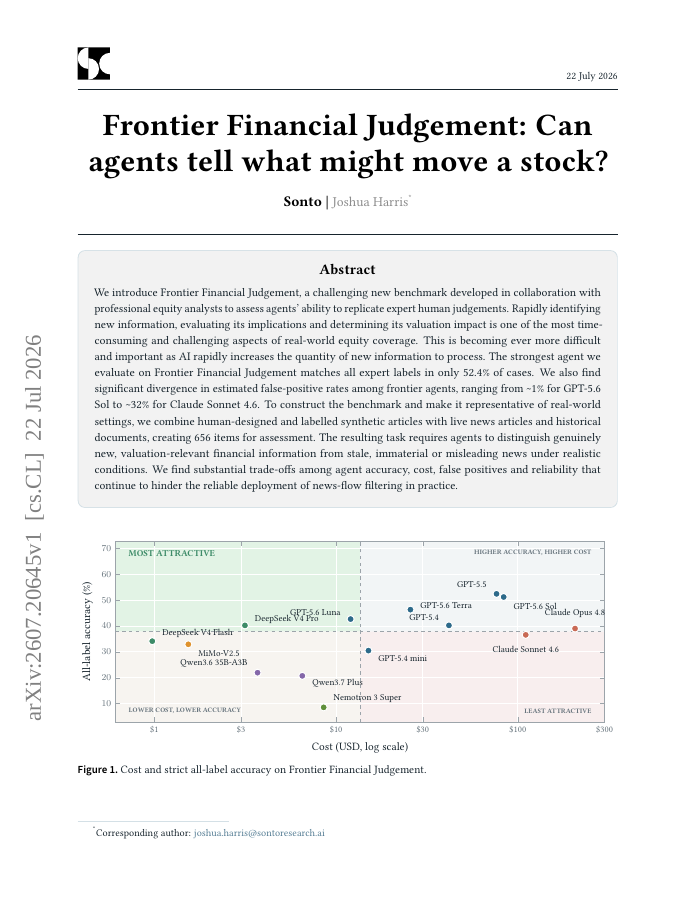
We introduce Frontier Financial Judgement, a challenging new benchmark developed in collaboration with professional equity analysts to assess agents' ability to replicate expert human judgements. Rapidly identifying new information, evaluating its implications and determining its valuation impact is one of the most time-consuming and challenging aspects of real-world equity coverage. This is becoming ever more difficult and important as AI rapidly increases the quantity of new information to process. The strongest agent we evaluate on Frontier Financial Judgement matches all expert labels in only 52.4% of cases. We also find significant divergence in estimated false-positive rates among frontier agents, ranging from 1% for GPT-5.6 Sol to 32% for Claude Sonnet 4.6. To construct the benchmark and make it representative of real-world settings, we combine human-designed and labelled synthetic articles with live news articles and historical documents, creating 656 items for assessment. The resulting task requires agents to distinguish genuinely new, valuation-relevant financial information from stale, immaterial or misleading news under realistic conditions. We find substantial trade-offs among agent accuracy, cost, false positives and reliability that continue to hinder the reliable deployment of news-flow filtering in practice.
Frontier Financial Judgement: Can agents tell what might move a stock?
We introduce Frontier Financial Judgement, a challenging new benchmark developed in collaboration with professional equity analysts to assess agents' ability to replicate expert human judgements.
- Preview
- Year
- 2026
- Hosting
- Full text hostedCC-BY-4.0
Cite
Notes
Only stored in your browser.
Attribution
- Abstract & full text
- arxiv.org/abs/2607.20645CC-BY-4.0
- TL;DR
- Semantic Scholar