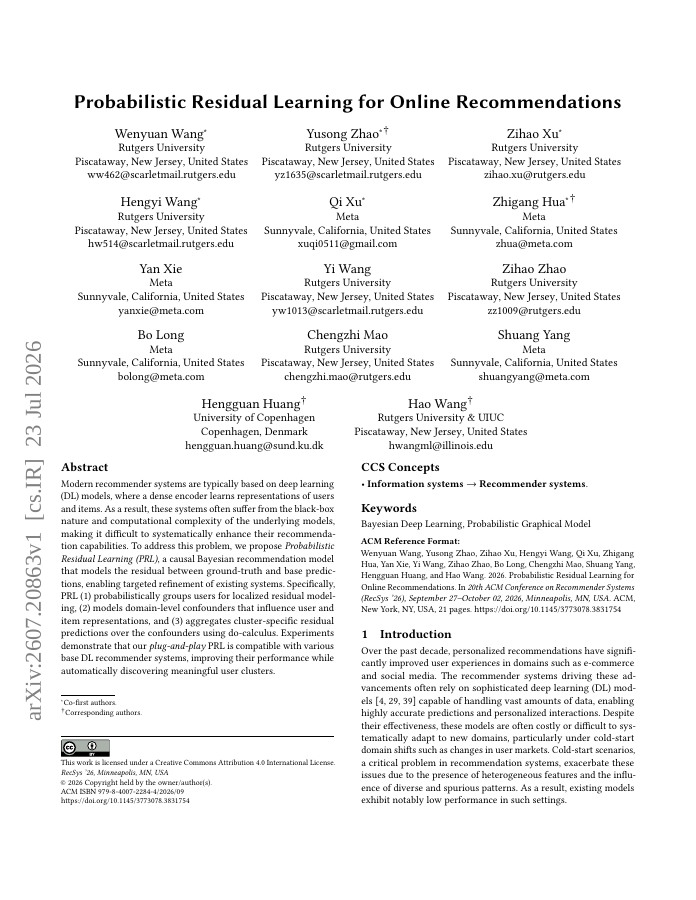
Modern recommender systems are typically based on deep learning (DL) models, where a dense encoder learns representations of users and items. As a result, these systems often suffer from the black-box nature and computational complexity of the underlying models, making it difficult to systematically enhance their recommendation capabilities. To address this problem, we propose Probabilistic Residual Learning (PRL), a causal Bayesian recommendation model that models the residual between ground-truth and base predictions, enabling targeted refinement of existing systems. Specifically, PRL (1) probabilistically groups users for localized residual modeling, (2) models domain-level confounders that influence user and item representations, and (3) aggregates cluster-specific residual predictions over the confounders using do-calculus. Experiments demonstrate that our plug-and-play PRL is compatible with various base deep learning recommender systems, improving their performance while automatically discovering meaningful user clusters.
Probabilistic Residual Learning for Online Recommendations
Modern recommender systems are typically based on deep learning (DL) models, where a dense encoder learns representations of users and items. As a result, these systems often suffer from the black-box nature and computational complexity of the underlying models, making it…
- Preview
- Year
- 2026
- Hosting
- Full text hostedCC-BY-4.0
Cite
Notes
Only stored in your browser.
Attribution
- Abstract & full text
- arxiv.org/abs/2607.20863CC-BY-4.0
- TL;DR
- Semantic Scholar