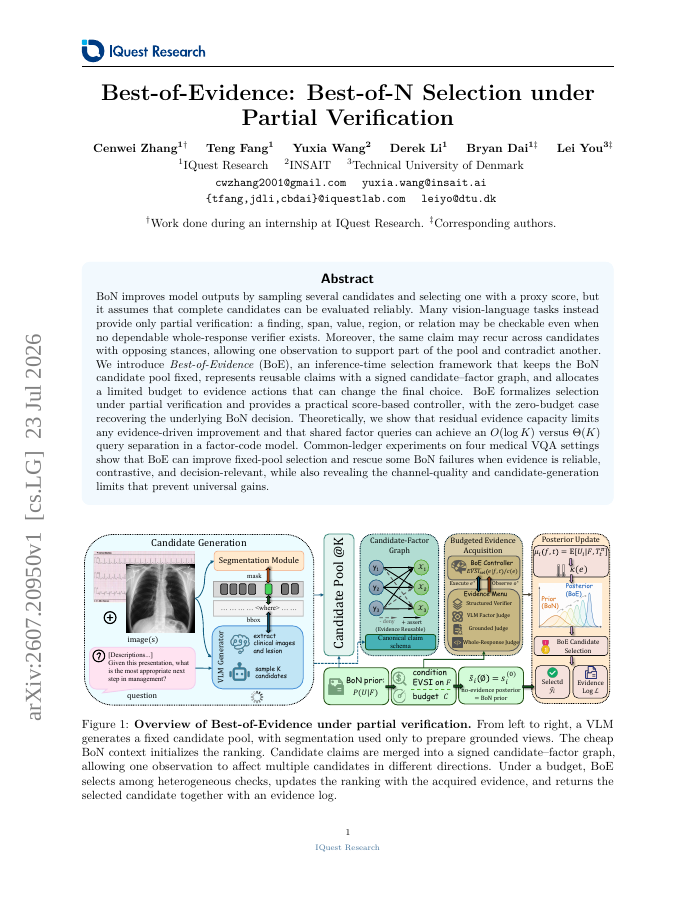
BoN improves model outputs by sampling several candidates and selecting one with a proxy score, but it assumes that complete candidates can be evaluated reliably. Many vision-language tasks instead provide only partial verification: a finding, span, value, region, or relation may be checkable even when no dependable whole-response verifier exists. Moreover, the same claim may recur across candidates with opposing stances, allowing one observation to support part of the pool and contradict another. We introduce Best-of-Evidence (BoE), an inference-time selection framework that keeps the BoN candidate pool fixed, represents reusable claims with a signed candidate--factor graph, and allocates a limited budget to evidence actions that can change the final choice. BoE formalizes selection under partial verification and provides a practical score-based controller, with the zero-budget case recovering the underlying BoN decision. Theoretically, we show that residual evidence capacity limits any evidence-driven improvement and that shared factor queries can achieve an O(log K) versus Θ(K) query separation in a factor-code model. Common-ledger experiments on four medical VQA settings show that BoE can improve fixed-pool selection and rescue some BoN failures when evidence is reliable, contrastive, and decision-relevant, while also revealing the channel-quality and candidate-generation limits that prevent universal gains.
Best-of-Evidence: Best-of-N Selection under Partial Verification
BoN improves model outputs by sampling several candidates and selecting one with a proxy score, but it assumes that complete candidates can be evaluated reliably. Many vision-language tasks instead provide only partial verification: a finding, span, value, region, or relation…
- Preview
- Year
- 2026
- Hosting
- Abstract onlyARXIV-DEFAULT
Cite
Notes
Only stored in your browser.
Attribution
- Abstract & full text
- arxiv.org/abs/2607.20950ARXIV-DEFAULT
- TL;DR
- Semantic Scholar