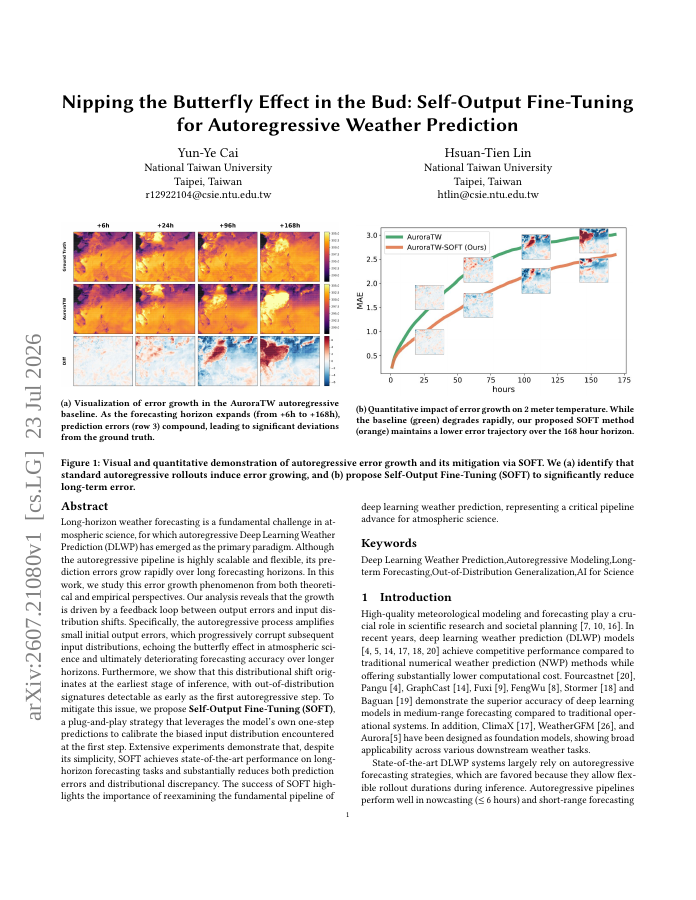
Long-horizon weather forecasting is a fundamental challenge in atmospheric science, for which autoregressive Deep Learning Weather Prediction (DLWP) has emerged as the primary paradigm. Although the autoregressive pipeline is highly scalable and flexible, its prediction errors grow rapidly over long forecasting horizons. In this work, we study this error growth phenomenon from both theoretical and empirical perspectives. Our analysis reveals that the growth is driven by a feedback loop between output errors and input distribution shifts. Specifically, the autoregressive process amplifies small initial output errors, which progressively corrupt subsequent input distributions, echoing the butterfly effect in atmospheric science and ultimately deteriorating forecasting accuracy over longer horizons. Furthermore, we show that this distributional shift originates at the earliest stage of inference, with out-of-distribution signatures detectable as early as the first autoregressive step. To mitigate this issue, we propose Self-Output Fine-Tuning (SOFT), a plug-and-play strategy that leverages the model's own one-step predictions to calibrate the biased input distribution encountered at the first step. Extensive experiments demonstrate that, despite its simplicity, SOFT achieves state-of-the-art performance on long-horizon forecasting tasks and substantially reduces both prediction errors and distributional discrepancy. The success of SOFT highlights the importance of reexamining the fundamental pipeline of deep learning weather prediction, representing a critical pipeline advance for atmospheric science.
Nipping the Butterfly Effect in the Bud: Self-Output Fine-Tuning for Autoregressive Weather Prediction
Long-horizon weather forecasting is a fundamental challenge in atmospheric science, for which autoregressive Deep Learning Weather Prediction (DLWP) has emerged as the primary paradigm.
- Preview
- Year
- 2026
- Hosting
- Full text hostedCC-BY-4.0
Cite
Notes
Only stored in your browser.
Attribution
- Abstract & full text
- arxiv.org/abs/2607.21080CC-BY-4.0
- TL;DR
- Semantic Scholar