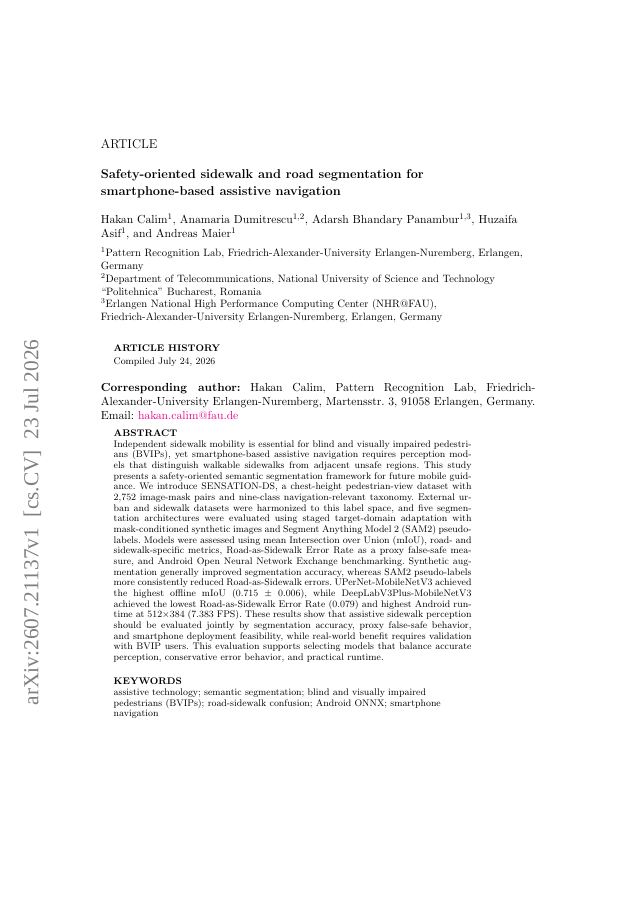
Independent sidewalk mobility is essential for blind and visually impaired pedestrians (BVIPs), yet smartphone-based assistive navigation requires perception models that distinguish walkable sidewalks from adjacent unsafe regions. This study presents a safety-oriented semantic segmentation framework for future mobile guidance. We introduce SENSATION-DS, a chest-height pedestrian-view dataset with 2,752 image-mask pairs and nine-class navigation-relevant taxonomy. External urban and sidewalk datasets were harmonized to this label space, and five segmentation architectures were evaluated using staged target-domain adaptation with mask-conditioned synthetic images and Segment Anything Model 2 (SAM2) pseudo-labels. Models were assessed using mean Intersection over Union (mIoU), road- and sidewalk-specific metrics, Road-as-Sidewalk Error Rate as a proxy false-safe measure, and Android Open Neural Network Exchange benchmarking. Synthetic augmentation generally improved segmentation accuracy, whereas SAM2 pseudo-labels more consistently reduced Road-as-Sidewalk errors. UPerNet-MobileNetV3 achieved the highest offline mIoU (0.715 +/- 0.006), while DeepLabV3Plus-MobileNetV3 achieved the lowest Road-as-Sidewalk Error Rate (0.079) and highest Android runtime at 512x384 (7.383 FPS). These results show that assistive sidewalk perception should be evaluated jointly by segmentation accuracy, proxy false-safe behavior, and smartphone deployment feasibility, while real-world benefit requires validation with BVIP users. This evaluation supports selecting models that balance accurate perception, conservative error behavior, and practical runtime.
Safety-oriented sidewalk and road segmentation for smartphone-based assistive navigation
Independent sidewalk mobility is essential for blind and visually impaired pedestrians (BVIPs), yet smartphone-based assistive navigation requires perception models that distinguish walkable sidewalks from adjacent unsafe regions.
- Preview
- Year
- 2026
- Hosting
- Full text hostedCC-BY-4.0
Cite
Notes
Only stored in your browser.
Attribution
- Abstract & full text
- arxiv.org/abs/2607.21137CC-BY-4.0
- TL;DR
- Semantic Scholar