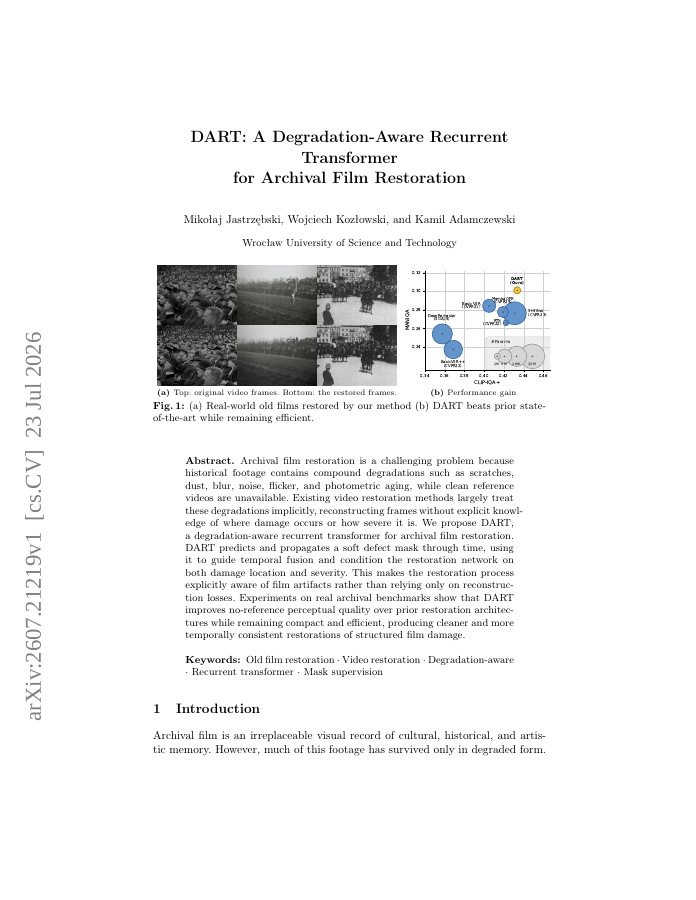
Archival film restoration is a challenging problem because historical footage contains compound degradations such as scratches, dust, blur, noise, flicker, and photometric aging, while clean reference videos are unavailable. Existing video restoration methods largely treat these degradations implicitly, reconstructing frames without explicit knowledge of where damage occurs or how severe it is. We propose DART, a degradation-aware recurrent transformer for archival film restoration. DART predicts and propagates a soft defect mask through time, using it to guide temporal fusion and condition the restoration network on both damage location and severity. This makes the restoration process explicitly aware of film artifacts rather than relying only on reconstruction losses. Experiments on real archival benchmarks show that DART improves no-reference perceptual quality over prior restoration architectures while remaining compact and efficient, producing cleaner and more temporally consistent restorations of structured film damage.
DART: A Degradation-Aware Recurrent Transformer for Archival Film Restoration
Archival film restoration is a challenging problem because historical footage contains compound degradations such as scratches, dust, blur, noise, flicker, and photometric aging, while clean reference videos are unavailable.
- Preview
- Year
- 2026
- Hosting
- Full text hostedCC-BY-4.0
Cite
Notes
Only stored in your browser.
Attribution
- Abstract & full text
- arxiv.org/abs/2607.21219CC-BY-4.0
- TL;DR
- Semantic Scholar