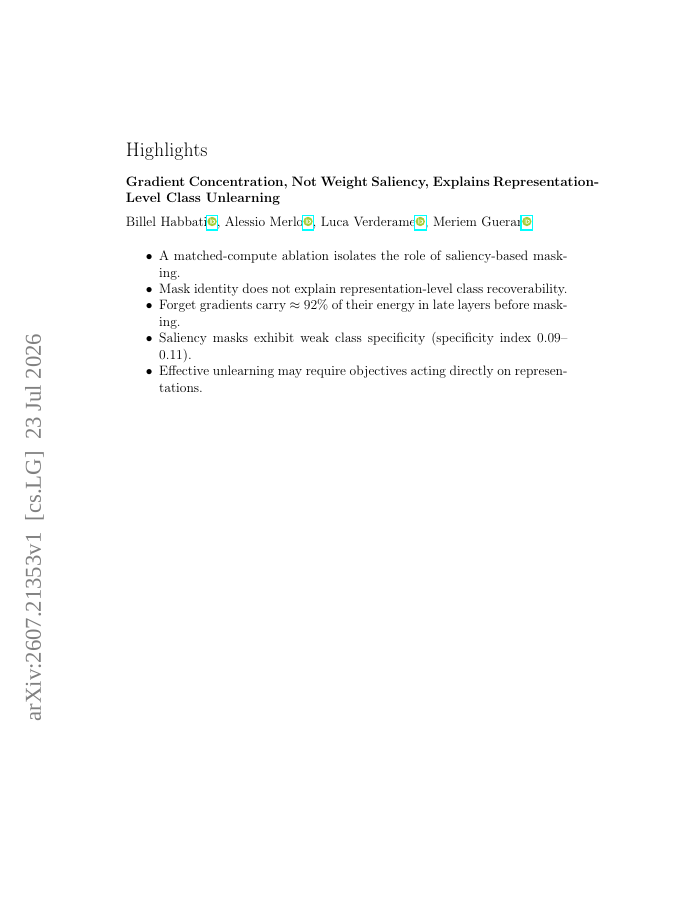
Machine unlearning aims to remove the influence of specific training data while preserving model utility. Many state-of-the-art approaches pursue this goal by restricting the forgetting update to a subset of parameters selected through gradient-based saliency. Although such methods are widely adopted, the actual contribution of saliency-based weight selection to representation-level forgetting remains unclear. In this work, we perform the first controlled ablation of the saliency masking mechanism used by SalUn. Using a matched-compute experimental design on CIFAR-10 and CIFAR-100 with ResNet-18, we compare saliency-based masking against random masks of equal sparsity and unconstrained updates, while keeping the unlearning objective, optimization schedule, and computational budget fixed. Across multiple representation-level evaluations, including linear probing, prototype recovery, and layer-wise CKA, the three configurations exhibit statistically equivalent representation-level recoverability. We find that forget gradients are strongly concentrated in the final network layers (approximately 92% of the squared gradient energy on CIFAR-10) before any mask is applied, causing all masking strategies to operate within the same representational subspace. Furthermore, saliency masks show limited class specificity (specificity index 0.09-0.11), selecting highly overlapping parameter subsets across different forget classes. Our findings suggest that, in the studied setting, representation-level forgetting is primarily governed by gradient concentration and representation geometry rather than by the specific identity of saliency-selected weights. More broadly, the results support a growing body of evidence indicating that effective representation-level unlearning requires objectives that act directly on latent representations rather than on increasingly sophisticated weight-selection strategies.
Gradient Concentration, Not Weight Saliency, Explains Representation-Level Class Unlearning
Machine unlearning aims to remove the influence of specific training data while preserving model utility. Many state-of-the-art approaches pursue this goal by restricting the forgetting update to a subset of parameters selected through gradient-based saliency.
- Preview
- Year
- 2026
- Hosting
- Abstract onlyARXIV-DEFAULT
Cite
Notes
Only stored in your browser.
Attribution
- Abstract & full text
- arxiv.org/abs/2607.21353ARXIV-DEFAULT
- TL;DR
- Semantic Scholar