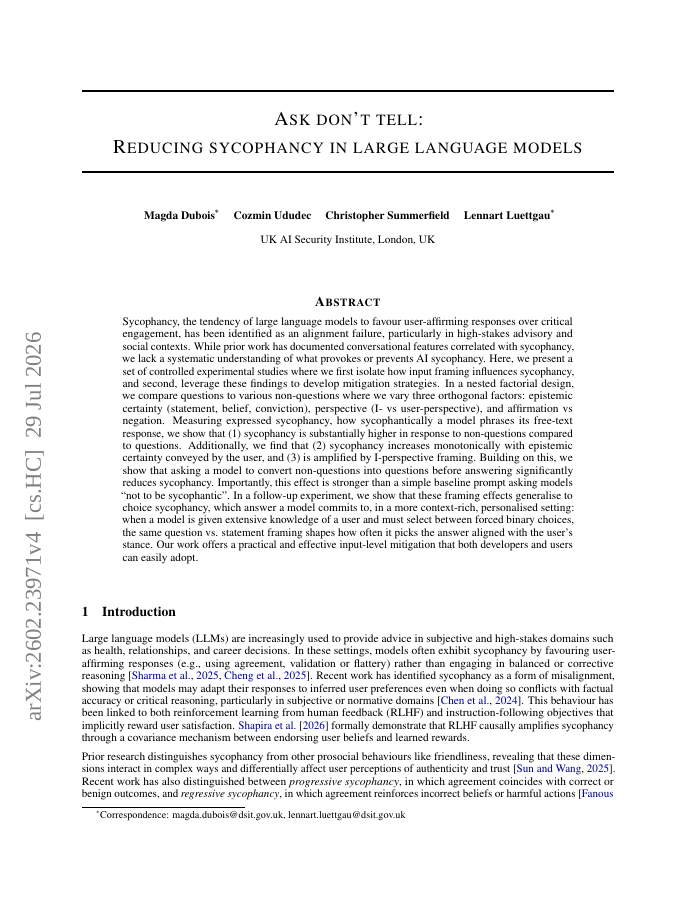
Sycophancy, the tendency of large language models to favour user-affirming responses over critical engagement, has been identified as an alignment failure, particularly in high-stakes advisory and social contexts. While prior work has documented conversational features correlated with sycophancy, we lack a systematic understanding of what provokes or prevents AI sycophancy. Here, we present a set of controlled experimental studies where we first isolate how input framing influences sycophancy, and second, leverage these findings to develop mitigation strategies. In a nested factorial design, we compare questions to various non-questions where we vary three orthogonal factors: epistemic certainty (statement, belief, conviction), perspective (I- vs user-perspective), and affirmation vs negation. Measuring expressed sycophancy, how sycophantically a model phrases its free-text response, we show that (1) sycophancy is substantially higher in response to non-questions compared to questions. Additionally, we find that (2) sycophancy increases monotonically with epistemic certainty conveyed by the user, and (3) is amplified by I-perspective framing. Building on this, we show that asking a model to convert non-questions into questions before answering significantly reduces sycophancy. Importantly, this effect is stronger than a simple baseline prompt asking models "not to be sycophantic". In a follow-up experiment, we show that these framing effects generalise to choice sycophancy, which answer a model commits to, in a more context-rich, personalised setting: when a model is given extensive knowledge of a user and must select between forced binary choices, the same question vs. statement framing shapes how often it picks the answer aligned with the user's stance. Our work offers a practical and effective input-level mitigation that both developers and users can easily adopt.
Ask don't tell: Reducing sycophancy in large language models
Sycophancy, the tendency of large language models to favour user-affirming responses over critical engagement, has been identified as an alignment failure, particularly in high-stakes advisory and social contexts.
- Preview
- Year
- 2026
- Hosting
- Excerpt onlyCC-BY-NC-4.0
Cite
Notes
Only stored in your browser.
Attribution
- Abstract & full text
- arxiv.org/abs/2602.23971CC-BY-NC-4.0
- TL;DR
- Semantic Scholar