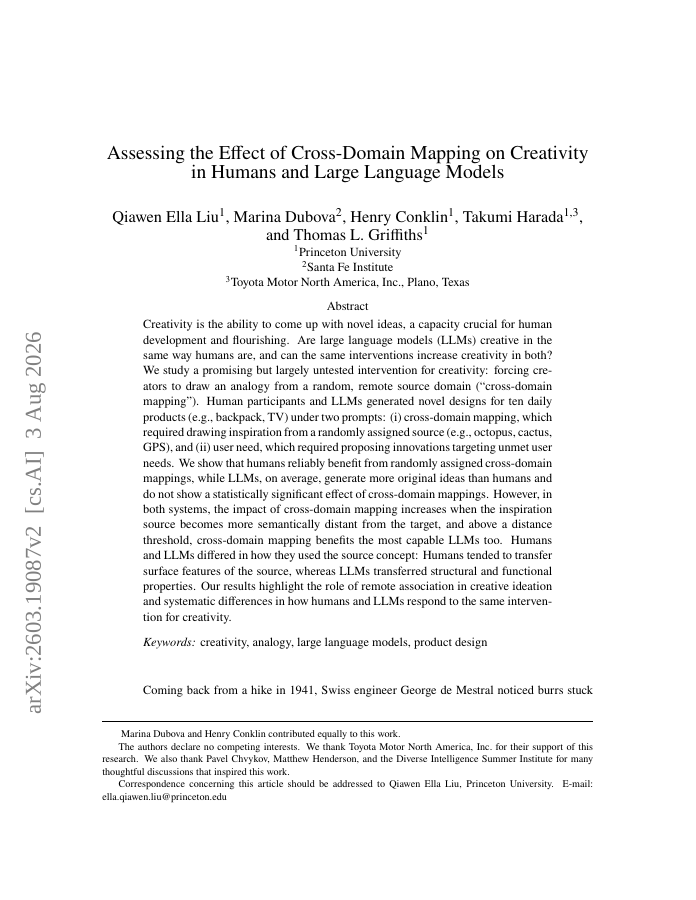
Creativity is the ability to come up with novel ideas, a capacity crucial for human development and flourishing. Are large language models (LLMs) creative in the same way humans are, and can the same interventions increase creativity in both? We study a promising but largely untested intervention for creativity: forcing creators to draw an analogy from a random, remote source domain (''cross-domain mapping''). Human participants and LLMs generated novel designs for ten daily products (e.g., backpack, TV) under two prompts: (i) cross-domain mapping, which required drawing inspiration from a randomly assigned source (e.g., octopus, cactus, GPS), and (ii) user need, which required proposing innovations targeting unmet user needs. We show that humans reliably benefit from randomly assigned cross-domain mappings, while LLMs, on average, generate more original ideas than humans and do not show a statistically significant effect of cross-domain mappings. However, in both systems, the impact of cross-domain mapping increases when the inspiration source becomes more semantically distant from the target, and above a distance threshold, cross-domain mapping benefits the most capable LLMs too. Humans and LLMs differed in how they used the source concept: Humans tended to transfer surface features of the source, whereas LLMs transferred structural and functional properties. Our results highlight the role of remote association in creative ideation and systematic differences in how humans and LLMs respond to the same intervention for creativity.
Assessing the Effect of Cross-Domain Mapping on Creativity in Humans and Large Language Models
Creativity is the ability to come up with novel ideas, a capacity crucial for human development and flourishing. Are large language models (LLMs) creative in the same way humans are, and can the same interventions increase creativity in both? We study a promising but largely…
- Preview
- Year
- 2026
- Hosting
- Full text hostedCC-BY-4.0
Cite
Notes
Only stored in your browser.
Attribution
- Abstract & full text
- arxiv.org/abs/2603.19087CC-BY-4.0
- TL;DR
- Semantic Scholar