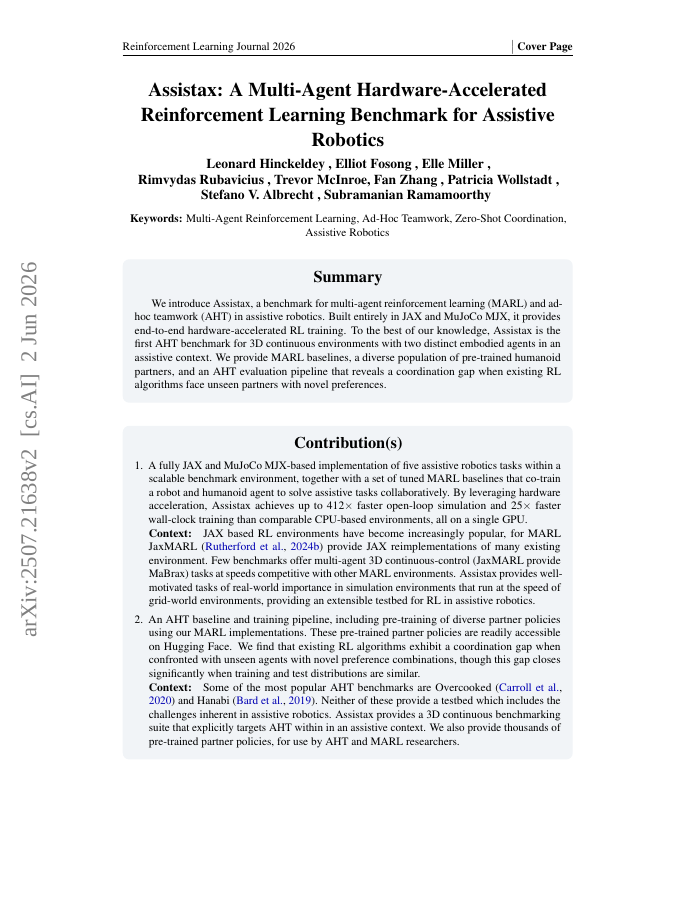
As embodied autonomous systems capable of assisting humans in daily activities remain a major goal for robotics, efficient and appropriate reinforcement learning (RL) simulation testbeds are increasingly important. Many common RL environments are too simple to provide insight into complex robotics domains, and many robotics simulations have throughput too low for RL. Very few simulators target multi-agent interactions: most treat the robot as an isolated agent, yet real-world tasks such as home assistance and caretaking are inherently multi-agent. Assistax addresses these limitations by providing a high-throughput, scalable suite of GPU-accelerated assistive robotics tasks built on JAX and MuJoCo-MJX, and includes an active humanoid agent as a simulated human partner, trainable alongside the robot using multi-agent RL (MARL). Beyond its use as a MARL benchmark, we formulate the human-robot interaction as an Ad-Hoc Teamwork (AHT) problem, where the robot's policy must generalise to unseen humans with varying disabilities and preferences. To this end, we provide an extensive AHT benchmarking pipeline: we use MARL to pre-train a diverse population of humanoid partners, and evaluate robot policies' ability to coordinate with a withheld set of humanoid policies. In contrast to other benchmarks, we also release reactive MARL-pre-trained humanoid policies via Hugging Face, enabling faster iteration in AHT research. With hardware acceleration, Assistax achieves up to 412\times faster open-loop simulation than comparable CPU-based environments on a single GPU. Our AHT pipeline reveals a coordination gap for existing RL algorithms on unseen partners with novel preference combinations. This RL-native test suite for embodied multi-agent interaction provides a practical benchmark for advancing RL in assistive care. Code is available at: https://github.com/assistive-autonomy/assistax.
Assistax: A Multi-Agent Hardware-Accelerated Reinforcement Learning Benchmark for Assistive Robotics
As embodied autonomous systems capable of assisting humans in daily activities remain a major goal for robotics, efficient and appropriate reinforcement learning (RL) simulation testbeds are increasingly important.
- Preview
- Year
- 2025
- Hosting
- Full text hostedCC-BY-4.0
Cite
Notes
Only stored in your browser.
Attribution
- Abstract & full text
- arxiv.org/abs/2507.21638CC-BY-4.0
- TL;DR
- Semantic Scholar