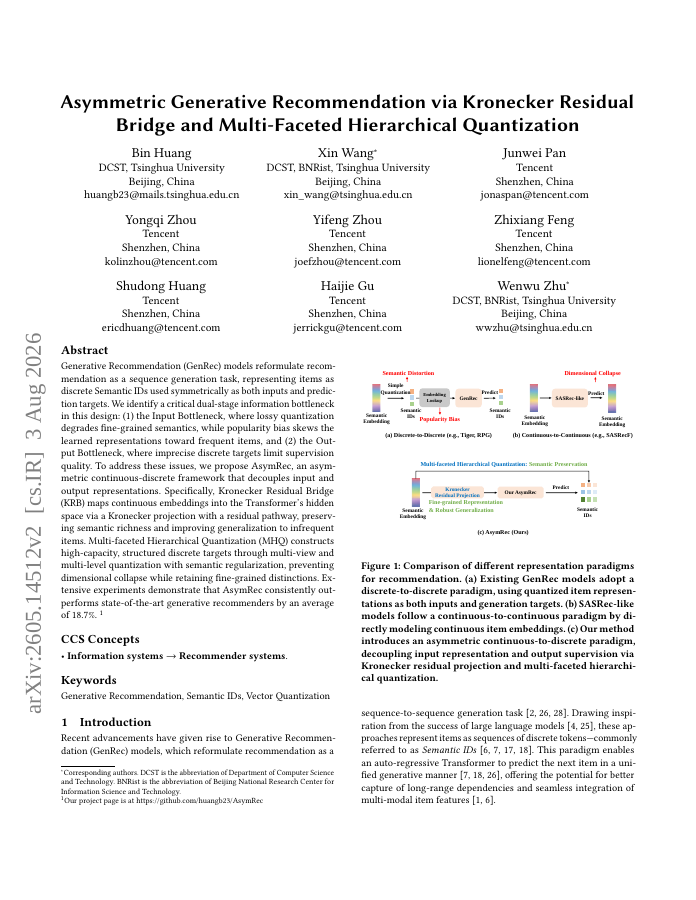
Generative Recommendation (GenRec) models reformulate recommendation as a sequence generation task, representing items as discrete Semantic IDs used symmetrically as both inputs and prediction targets. We identify a critical dual-stage information bottleneck in this design: (1) the Input Bottleneck, where lossy quantization degrades fine-grained semantics, while popularity bias skews learned representations toward frequent items, and (2) the Output Bottleneck, where imprecise discrete targets limit supervision quality. To address these issues, we propose AsymRec, an asymmetric continuous-discrete framework that decouples input and output representations. Specifically, Kronecker Residual Bridge (KRB) maps continuous embeddings into the Transformer's hidden space via a Kronecker projection with a residual pathway, preserving semantic richness and improving generalization to infrequent items. Multi-faceted Hierarchical Quantization (MHQ) constructs high-capacity, structured discrete targets through multi-view and multi-level quantization with semantic regularization, preventing dimensional collapse while retaining fine-grained distinctions. Extensive experiments demonstrate that AsymRec consistently outperforms state-of-the-art generative recommenders by an average of 18.7%. Our project page is available at https://github.com/huangb23/AsymRec.
Asymmetric Generative Recommendation via Kronecker Residual Bridge and Multi-Faceted Hierarchical Quantization
Generative Recommendation (GenRec) models reformulate recommendation as a sequence generation task, representing items as discrete Semantic IDs used symmetrically as both inputs and prediction targets.
- Preview
- Year
- 2026
- Hosting
- Excerpt onlyCC-BY-NC-4.0
Cite
Notes
Only stored in your browser.
Attribution
- Abstract & full text
- arxiv.org/abs/2605.14512CC-BY-NC-4.0
- TL;DR
- Semantic Scholar