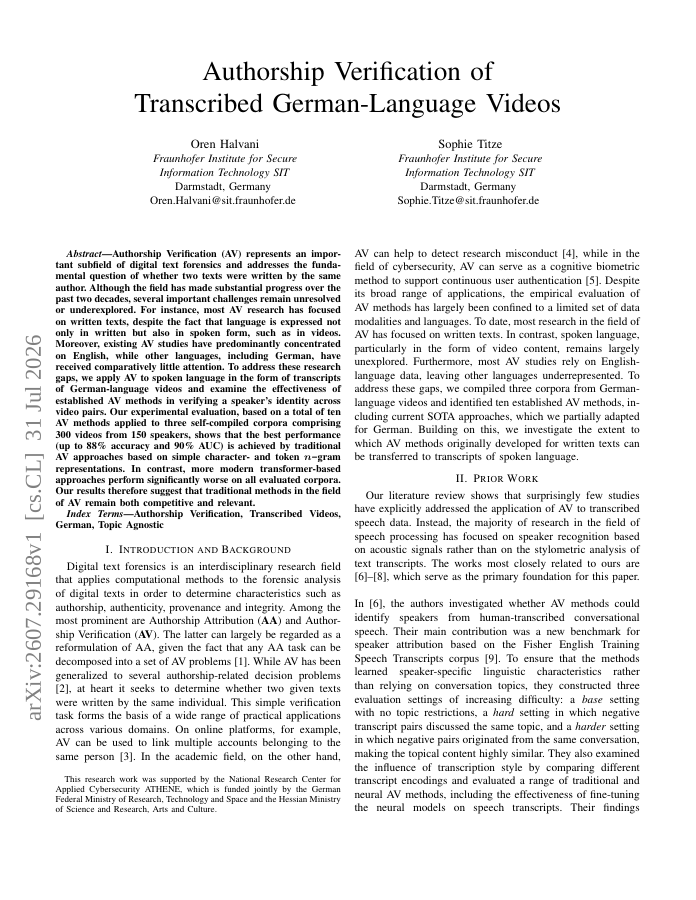
Authorship Verification (AV) represents an important subfield of digital text forensics and addresses the fundamental question of whether two texts were written by the same author. Although the field has made substantial progress over the past two decades, several important challenges remain unresolved or underexplored. For instance, most AV research has focused on written texts, despite the fact that language is expressed not only in written but also in spoken form, such as in videos. Moreover, existing AV studies have predominantly concentrated on English, while other languages, including German, have received comparatively little attention. To address these research gaps, we apply AV to spoken language in the form of transcripts of German-language videos and examine the effectiveness of established AV methods in verifying a speaker's identity across video pairs. Our experimental evaluation, based on a total of ten AV methods applied to three self-compiled corpora comprising 300 videos from 150 speakers, shows that the best performance (up to 88% accuracy and 90% AUC) is achieved by traditional AV approaches based on simple character- and token n-gram representations. In contrast, more modern transformer-based approaches perform significantly worse on all evaluated corpora. Our results therefore suggest that traditional methods in the field of AV remain both competitive and relevant.
Authorship Verification of Transcribed German-Language Videos
Authorship Verification (AV) represents an important subfield of digital text forensics and addresses the fundamental question of whether two texts were written by the same author.
- Preview
- Year
- 2026
- Hosting
- Full text hostedCC-BY-4.0
Cite
Notes
Only stored in your browser.
Attribution
- Abstract & full text
- arxiv.org/abs/2607.29168CC-BY-4.0
- TL;DR
- Semantic Scholar