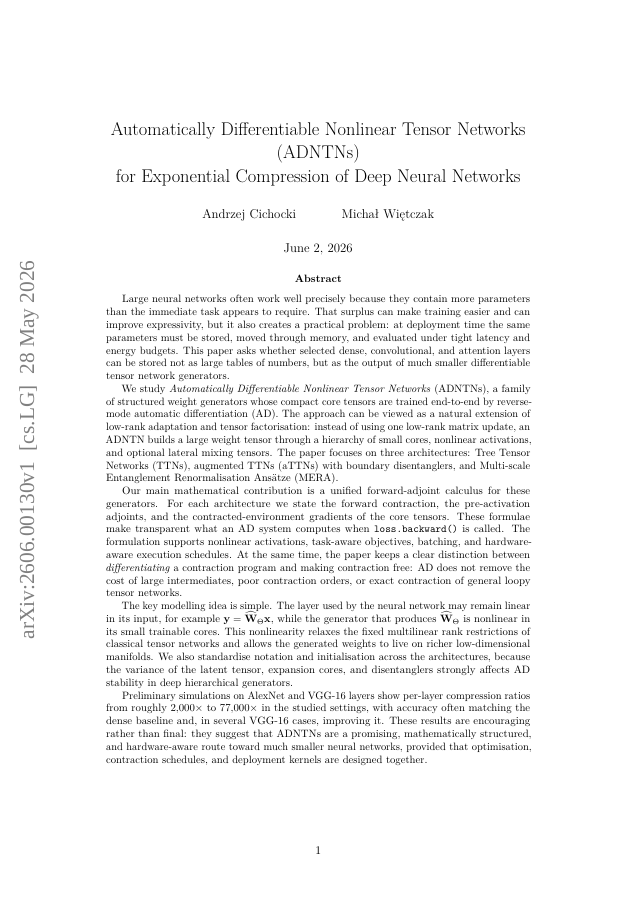
Large deep neural networks are costly to store and deploy because inference must move and evaluate many parameters. This paper studies Automatically Differentiable Nonlinear Tensor Networks (ADNTNs), compact differentiable weight generators for replacing selected dense, convolutional, and attention layers. An ADNTN maps a small set of trainable tensor cores to a full weight tensor through hierarchical contractions and learnable nonlinearities; the generated layer is then used as an ordinary linear or convolutional operator. We investigate three multilayered topologies: Tree Tensor Networks, augmented Tree Tensor Networks with boundary disentanglers, and MERA-style multi-scale decoders. Compared with flat brick-wall automatically differentiable tensor networks, these hierarchies provide logarithmic-depth communication between tensorised modes and optional lateral mixing, which can improve long-range structure without large increases in stored parameters. We give a unified forward--adjoint formulation showing how reverse-mode automatic differentiation computes pre-activation adjoints and contracted-environment gradients for all trainable cores. The formulation supports task losses, reconstruction losses, distillation, quantisation-aware terms, batching, and modern optimisers. Proof-of-concept experiments on selected AlexNet and VGG-16 layers on CIFAR-10 datasets achieve per-layer parameter-compression ratios from about 2{,}000\times to 430{,}000\times. Several VGG-16 compressed models match or slightly exceed the dense baseline, whereas AlexNet shows moderate degradation under more restrictive redundancy. These results indicate that nonlinear tensor-network generators are a promising structured route to compact pattern-recognition models, while also showing that contraction schedules and hardware-aware implementations remain essential for practical speedups.
Automatically Differentiable Nonlinear Tensor Networks (ADNTNs) for Exponential Parameter Compression of Deep Neural Networks
Large deep neural networks are costly to store and deploy because inference must move and evaluate many parameters. This paper studies \emph{Automatically Differentiable Nonlinear Tensor Networks} (ADNTNs), compact differentiable weight generators for replacing selected dense,…
- Preview
- Year
- 2026
- Hosting
- Excerpt onlyCC-BY-NC-SA-4.0
Cite
Notes
Only stored in your browser.
Attribution
- Abstract & full text
- arxiv.org/abs/2606.00130CC-BY-NC-SA-4.0
- TL;DR
- Semantic Scholar