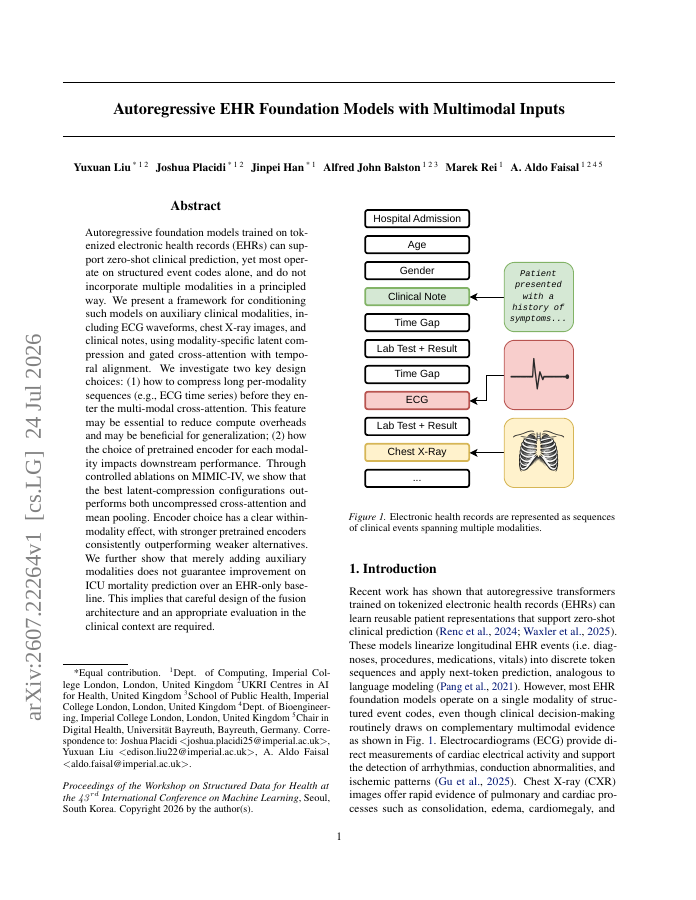
Autoregressive foundation models trained on tokenized electronic health records (EHRs) can support zero-shot clinical prediction, yet most operate on structured event codes alone, and do not incorporate multiple modalities in a principled way. We present a framework for conditioning such models on auxiliary clinical modalities, including ECG waveforms, chest X-ray images, and clinical notes, using modality-specific latent compression and gated cross-attention with temporal alignment. We investigate two key design choices: (1) how to compress long per-modality sequences (e.g., ECG time series) before they enter the multi-modal cross-attention. This feature may be essential to reduce compute overheads and may be beneficial for generalization; (2) how the choice of pretrained encoder for each modality impacts downstream performance. Through controlled ablations on MIMIC-IV, we show that the best latent-compression configurations outperforms both uncompressed cross-attention and mean pooling. Encoder choice has a clear within-modality effect, with stronger pretrained encoders consistently outperforming weaker alternatives. We further show that merely adding auxiliary modalities does not guarantee improvement on ICU mortality prediction over an EHR-only baseline. This implies that careful design of the fusion architecture and an appropriate evaluation in the clinical context are required.
Autoregressive EHR Foundation Models with Multimodal Inputs
Autoregressive foundation models trained on tokenized electronic health records (EHRs) can support zero-shot clinical prediction, yet most operate on structured event codes alone, and do not incorporate multiple modalities in a principled way.
- Preview
- Year
- 2026
- Hosting
- Abstract onlyARXIV-DEFAULT
Cite
Notes
Only stored in your browser.
Attribution
- Abstract & full text
- arxiv.org/abs/2607.22264ARXIV-DEFAULT
- TL;DR
- Semantic Scholar