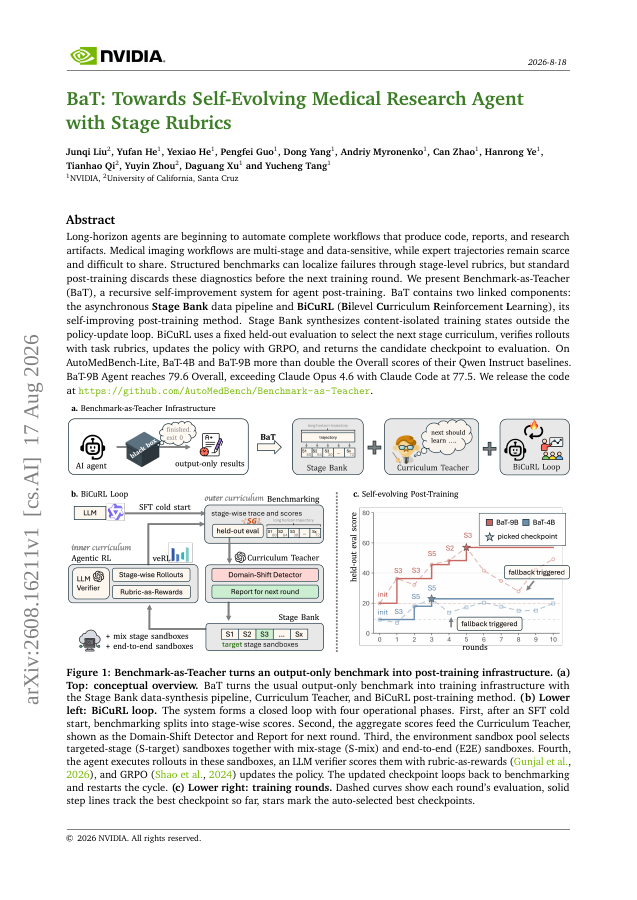
Long-horizon agents are beginning to automate complete workflows that produce code, reports, and research artifacts. Medical imaging workflows are multi-stage and data-sensitive, while expert trajectories remain scarce and difficult to share. Structured benchmarks can localize failures through stage-level rubrics, but standard post-training discards these diagnostics before the next training round. We present Benchmark-as-Teacher (BaT), a recursive self-improvement system for agent post-training. BaT contains two linked components: the asynchronous Stage Bank data pipeline and BiCuRL (Bilevel Curriculum Reinforcement Learning), its self-improving post-training method. Stage Bank synthesizes content-isolated training states outside the policy-update loop. BiCuRL uses a fixed held-out evaluation to select the next stage curriculum, verifies rollouts with task rubrics, updates the policy with GRPO, and returns the candidate checkpoint to evaluation. On AutoMedBench-Lite, BaT-4B and BaT-9B more than double the Overall scores of their Qwen Instruct baselines. BaT-9B Agent reaches 79.6 Overall, exceeding Claude Opus 4.6 with Claude Code at 77.5.
BaT: Towards Self-Evolving Medical Research Agent with Stage Rubrics
Long-horizon agents are beginning to automate complete workflows that produce code, reports, and research artifacts. Medical imaging workflows are multi-stage and data-sensitive, while expert trajectories remain scarce and difficult to share.
- Preview
- Year
- 2026
- Hosting
- Excerpt onlyCC-BY-NC-SA-4.0
Cite
Notes
Only stored in your browser.
Attribution
- Abstract & full text
- arxiv.org/abs/2608.16211CC-BY-NC-SA-4.0
- TL;DR
- Semantic Scholar