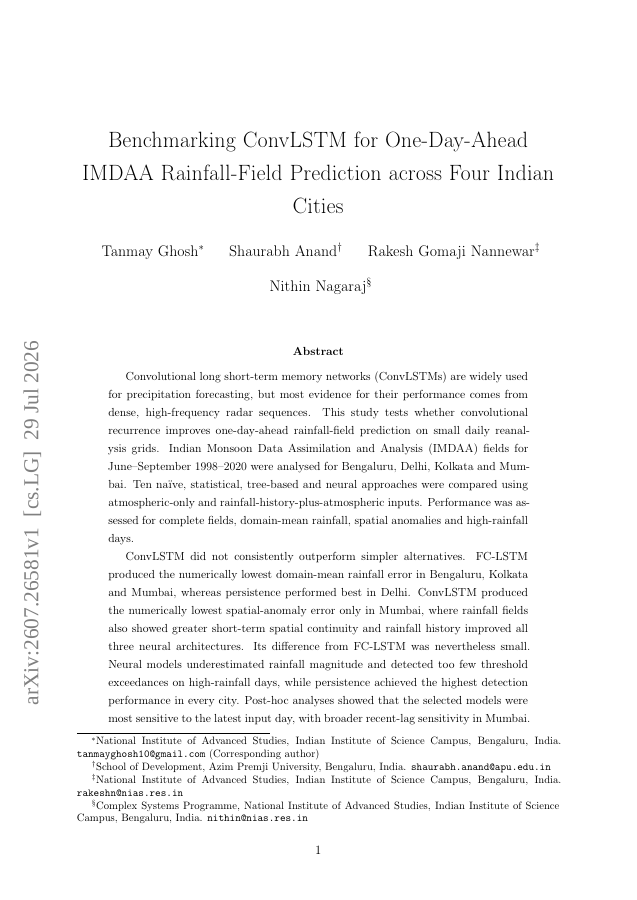
Convolutional long short-term memory networks (ConvLSTMs) are widely used for precipitation forecasting, but most evidence for their performance comes from dense, high-frequency radar sequences. This study tests whether convolutional recurrence improves one-day-ahead rainfall-field prediction on small daily reanalysis grids. Indian Monsoon Data Assimilation and Analysis (IMDAA) fields for June-September 1998-2020 were analysed for Bengaluru, Delhi, Kolkata and Mumbai. Ten naive, statistical, tree-based and neural approaches were compared using atmospheric-only and rainfall-history-plus-atmospheric inputs. Performance was assessed for complete fields, domain-mean rainfall, spatial anomalies and high-rainfall days. ConvLSTM did not consistently outperform simpler alternatives. FC-LSTM produced the numerically lowest domain-mean rainfall error in Bengaluru, Kolkata and Mumbai, whereas persistence performed best in Delhi. ConvLSTM produced the numerically lowest spatial-anomaly error only in Mumbai, where rainfall fields showed greater short-term spatial continuity and rainfall-history inputs improved all three neural architectures. The difference between ConvLSTM and FC-LSTM was nevertheless small. Neural models underestimated rainfall magnitude and predicted too few threshold exceedances on high-rainfall days, while persistence achieved the highest detection performance in every city. Post-hoc analyses showed that the selected models were most sensitive to the latest input day, with broader recent-lag sensitivity in Mumbai. These findings show that gridded inputs alone do not justify ConvLSTM and that architecture choice should follow strong benchmarking across average, spatial and high-rainfall performance.
Benchmarking ConvLSTM for One-Day-Ahead IMDAA Rainfall-Field Prediction across Four Indian Cities
Convolutional long short-term memory networks (ConvLSTMs) are widely used for precipitation forecasting, but most evidence for their performance comes from dense, high-frequency radar sequences.
- Preview
- Year
- 2026
- Hosting
- Abstract onlyARXIV-DEFAULT
Cite
Notes
Only stored in your browser.
Attribution
- Abstract & full text
- arxiv.org/abs/2607.26581ARXIV-DEFAULT
- TL;DR
- Semantic Scholar