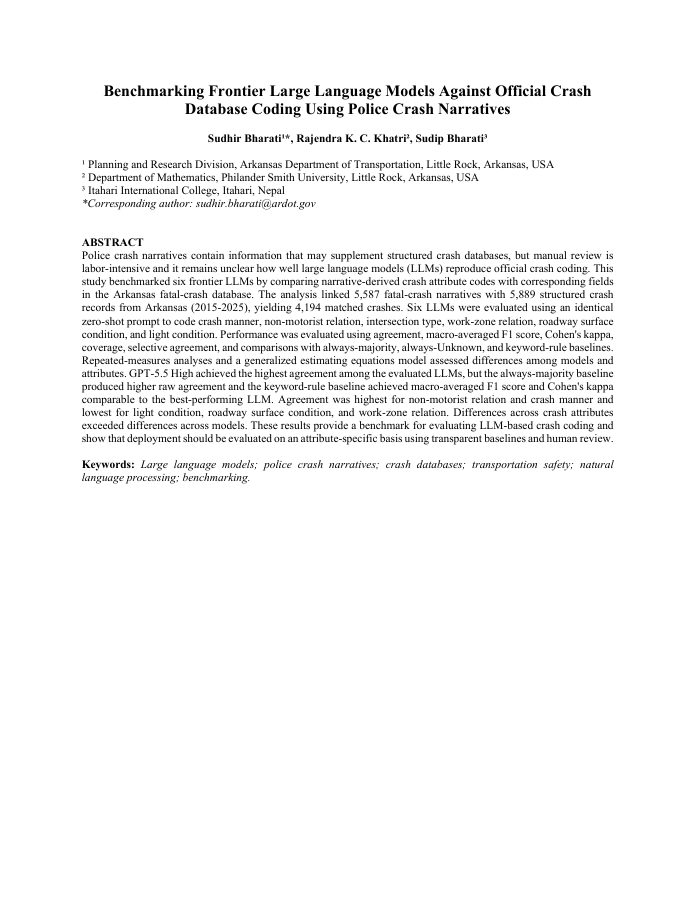
Police crash narratives contain information that may supplement structured crash databases, but manual review is labor-intensive and it remains unclear how well large language models (LLMs) reproduce official crash coding. This study benchmarked six frontier LLMs by comparing narrative-derived crash attribute codes with corresponding fields in the Arkansas fatal-crash database. The analysis linked 5,587 fatal-crash narratives with 5,889 structured crash records from Arkansas (2015-2025), yielding 4,194 matched crashes. Six LLMs were evaluated using an identical zero-shot prompt to code crash manner, non-motorist relation, intersection type, work-zone relation, roadway surface condition, and light condition. Performance was evaluated using agreement, macro-averaged F1 score, Cohen's kappa, coverage, selective agreement, and comparisons with always-majority, always-Unknown, and keyword-rule baselines. Repeated-measures analyses and a generalized estimating equations model assessed differences among models and attributes. GPT-5.5 High achieved the highest agreement among the evaluated LLMs, but the always-majority baseline produced higher raw agreement and the keyword-rule baseline achieved macro-averaged F1 score and Cohen's kappa comparable to the best-performing LLM. Agreement was highest for non-motorist relation and crash manner and lowest for light condition, roadway surface condition, and work-zone relation. Differences across crash attributes exceeded differences across models. These results provide a benchmark for evaluating LLM-based crash coding and show that deployment should be evaluated on an attribute-specific basis using transparent baselines and human review.
Benchmarking Frontier Large Language Models Against Official Crash Database Coding Using Police Crash Narratives
Police crash narratives contain information that may supplement structured crash databases, but manual review is labor-intensive and it remains unclear how well large language models (LLMs) reproduce official crash coding.
- Preview
- Year
- 2026
- Hosting
- Abstract onlyARXIV-DEFAULT
Cite
Notes
Only stored in your browser.
Attribution
- Abstract & full text
- arxiv.org/abs/2607.29064ARXIV-DEFAULT
- TL;DR
- Semantic Scholar