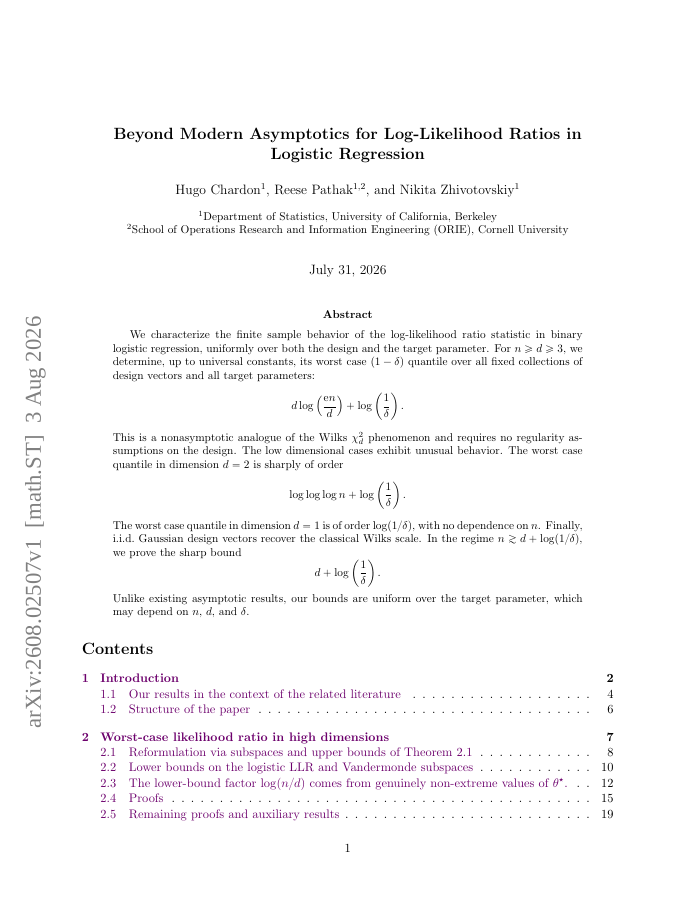
We characterize the finite sample behavior of the log-likelihood ratio statistic in binary logistic regression, uniformly over both the design and the target parameter. For n\geq d\geq 3, we determine, up to universal constants, its worst case (1-δ) quantile over all fixed collections of design vectors and all target parameters: [ d\log\left(\frac{e n}{d}\right)+\log\left(\frac{1}δ\right). ] This is a nonasymptotic analogue of the Wilks χ^2_d phenomenon and requires no regularity assumptions on the design. The low dimensional cases exhibit unusual behavior. The worst case quantile in dimension d=2 is sharply of order [ \log\log\log n+\log\left(\frac{1}δ\right). ] The worst case quantile in dimension d=1 is of order \log(1/δ), with no dependence on n. Finally, i.i.d. Gaussian design vectors recover the classical Wilks scale. In the regime n\gtrsim d+\log(1/δ), we prove the sharp bound [ d+\log\left(\frac{1}δ\right). ] Unlike existing asymptotic results, our bounds are uniform over the target parameter, which may depend on n, d, and δ.
Beyond Modern Asymptotics for Log-Likelihood Ratios in Logistic Regression
We characterize the finite sample behavior of the log-likelihood ratio statistic in binary logistic regression, uniformly over both the design and the target parameter. For $n\geq d\geq 3$, we determine, up to universal constants, its worst case $(1-δ)$ quantile over all fixed…
- Preview
- Year
- 2026
- Hosting
- Full text hostedCC-BY-4.0
Cite
Notes
Only stored in your browser.
Attribution
- Abstract & full text
- arxiv.org/abs/2608.02507CC-BY-4.0
- TL;DR
- Semantic Scholar