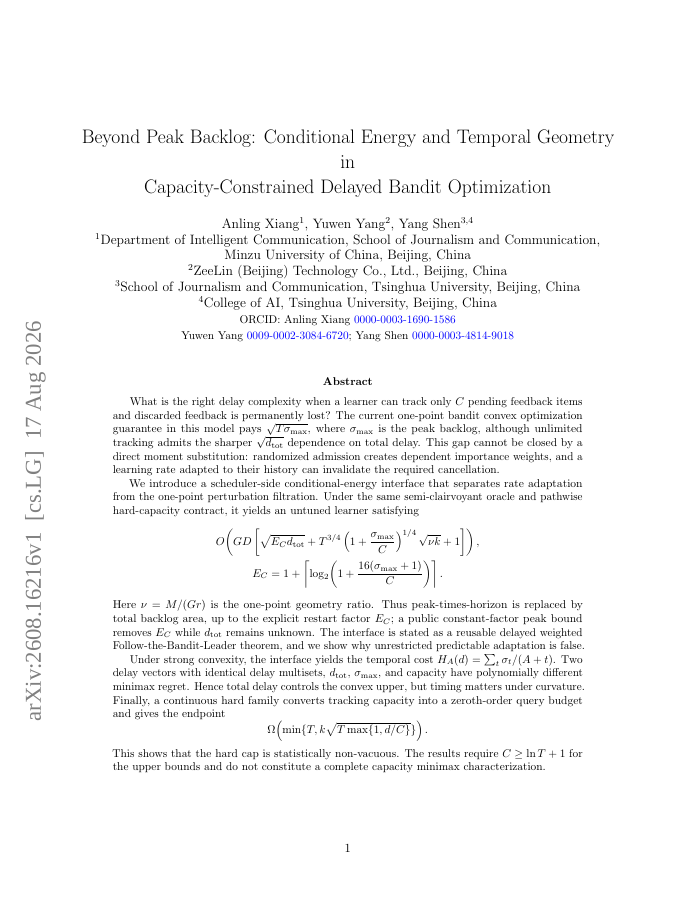
What is the right delay complexity when a learner can track only C pending feedback items and discarded feedback is permanently lost? Existing one-point bandit convex optimization guarantees in this model pay \sqrt{Tσ_{\max}}, where σ_{\max} is the peak backlog, although unlimited tracking admits the sharper \sqrt{d_{tot}} dependence on total delay. We introduce a scheduler-side conditional-energy interface that separates rate adaptation from the one-point perturbation filtration and handles the dependent importance weights created by randomized admission. Under the same semi-clairvoyant oracle and pathwise hard-capacity contract, this yields an untuned learner whose delay term scales as O(\sqrt{E_C d_{tot}}), with only an explicit restart factor E_C; a public constant-factor peak bound removes this factor while d_{tot} remains unknown. Under strong convexity, the same interface yields the temporal cost H_A(d)=\sum_t σ_t/(A+t). Two delay vectors with identical delay multisets, d_{tot}, σ_{\max}, and capacity can nevertheless have polynomially different minimax regret, showing that timing matters under curvature even when aggregate delay summaries agree. Finally, a continuous hard family converts tracking capacity into a zeroth-order query budget and gives a complementary capacity-starvation lower endpoint. The upper bounds require C\ge \ln T+1 and do not constitute a complete capacity minimax characterization.
Beyond Peak Backlog: Conditional Energy and Temporal Geometry in Capacity-Constrained Delayed Bandit Optimization
What is the right delay complexity when a learner can track only $C$ pending feedback items and discarded feedback is permanently lost? Existing one-point bandit convex optimization guarantees in this model pay $\sqrt{Tσ_{\max}}$, where $σ_{\max}$ is the peak backlog, although…
- Preview
- Year
- 2026
- Hosting
- Abstract onlyARXIV-DEFAULT
Cite
Notes
Only stored in your browser.
Attribution
- Abstract & full text
- arxiv.org/abs/2608.16216ARXIV-DEFAULT
- TL;DR
- Semantic Scholar