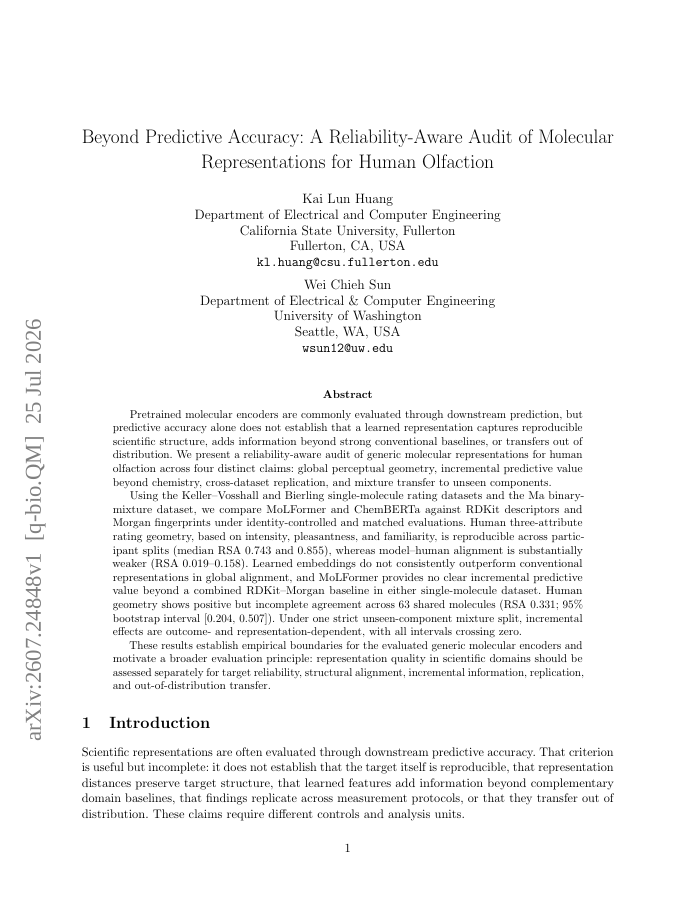
Pretrained molecular encoders are commonly evaluated through downstream prediction, but predictive accuracy alone does not establish that a learned representation captures reproducible scientific structure, adds information beyond strong conventional baselines, or transfers out of distribution. We present a reliability-aware audit of generic molecular representations for human olfaction across four distinct claims: global perceptual geometry, incremental predictive value beyond chemistry, cross-dataset replication, and mixture transfer to unseen components. Using the Keller-Vosshall and Bierling single-molecule rating datasets and the Ma binary-mixture dataset, we compare MoLFormer and ChemBERTa against RDKit descriptors and Morgan fingerprints under identity-controlled and matched evaluations. Human three-attribute rating geometry, based on intensity, pleasantness, and familiarity, is reproducible across participant splits (median RSA 0.743 and 0.855), whereas model-human alignment is substantially weaker (RSA 0.019-0.158). Learned embeddings do not consistently outperform conventional representations in global alignment, and MoLFormer provides no clear incremental predictive value beyond a combined RDKit-Morgan baseline in either single-molecule dataset. Human geometry shows positive but incomplete agreement across 63 shared molecules (RSA 0.331; 95% bootstrap interval [0.204, 0.507]). Under one strict unseen-component mixture split, incremental effects are outcome- and representation-dependent, with all intervals crossing zero. These results establish empirical boundaries for the evaluated generic molecular encoders and motivate a broader evaluation principle: representation quality in scientific domains should be assessed separately for target reliability, structural alignment, incremental information, replication, and out-of-distribution transfer.
Beyond Predictive Accuracy: A Reliability-Aware Audit of Molecular Representations for Human Olfaction
Pretrained molecular encoders are commonly evaluated through downstream prediction, but predictive accuracy alone does not establish that a learned representation captures reproducible scientific structure, adds information beyond strong conventional baselines, or transfers out…
- Preview
- Year
- 2026
- Hosting
- Abstract onlyARXIV-DEFAULT
Cite
Notes
Only stored in your browser.
Attribution
- Abstract & full text
- arxiv.org/abs/2607.24848ARXIV-DEFAULT
- TL;DR
- Semantic Scholar