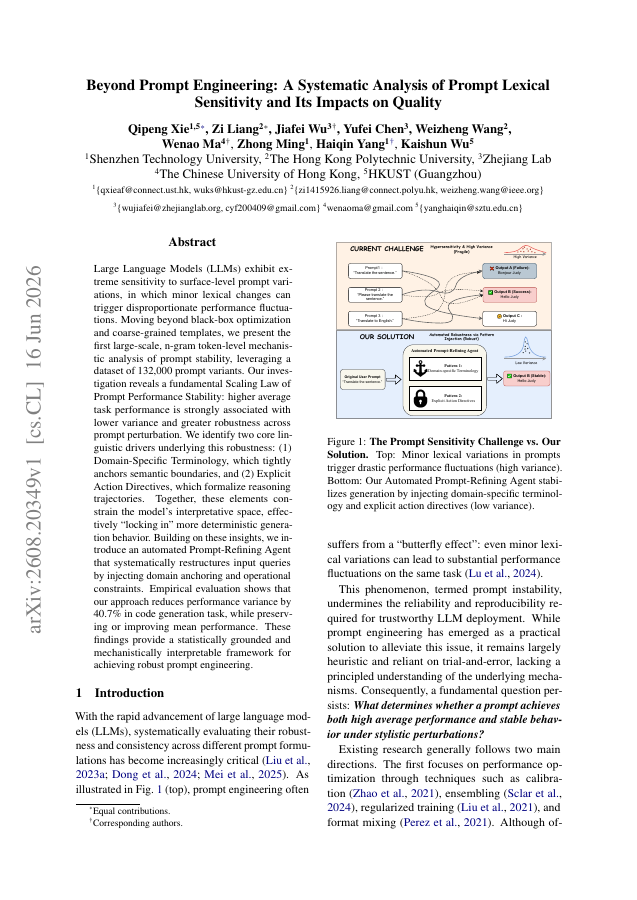
Large Language Models (LLMs) exhibit extreme sensitivity to surface-level prompt variations, in which minor lexical changes can trigger disproportionate performance fluctuations. Moving beyond black-box optimization and coarse-grained templates, we present the first large-scale, n-gram token-level mechanistic analysis of prompt stability, leveraging a dataset of 132,000 prompt variants. Our investigation reveals a fundamental Scaling Law of Prompt Performance Stability: higher average task performance is strongly associated with lower variance and greater robustness across prompt perturbation. We identify two core linguistic drivers underlying this robustness: (1) Domain-Specific Terminology, which tightly anchors semantic boundaries, and (2) Explicit Action Directives, which formalize reasoning trajectories. Together, these elements constrain the model's interpretative space, effectively ``locking in'' more deterministic generation behavior. Building on these insights, we introduce an automated Prompt-Refining Agent that systematically restructures input queries by injecting domain anchoring and operational constraints. Empirical evaluation shows that our approach reduces performance variance by 40.7% in code generation task, while preserving or improving mean performance. These findings provide a statistically grounded and mechanistically interpretable framework for achieving robust prompt engineering.
Beyond Prompt Engineering: A Systematic Analysis of Prompt Lexical Sensitivity and Its Impacts on Quality
Large Language Models (LLMs) exhibit extreme sensitivity to surface-level prompt variations, in which minor lexical changes can trigger disproportionate performance fluctuations.
- Preview
- Year
- 2026
- Hosting
- Abstract onlyARXIV-DEFAULT
Cite
Notes
Only stored in your browser.
Attribution
- Abstract & full text
- arxiv.org/abs/2608.20349ARXIV-DEFAULT
- TL;DR
- Semantic Scholar