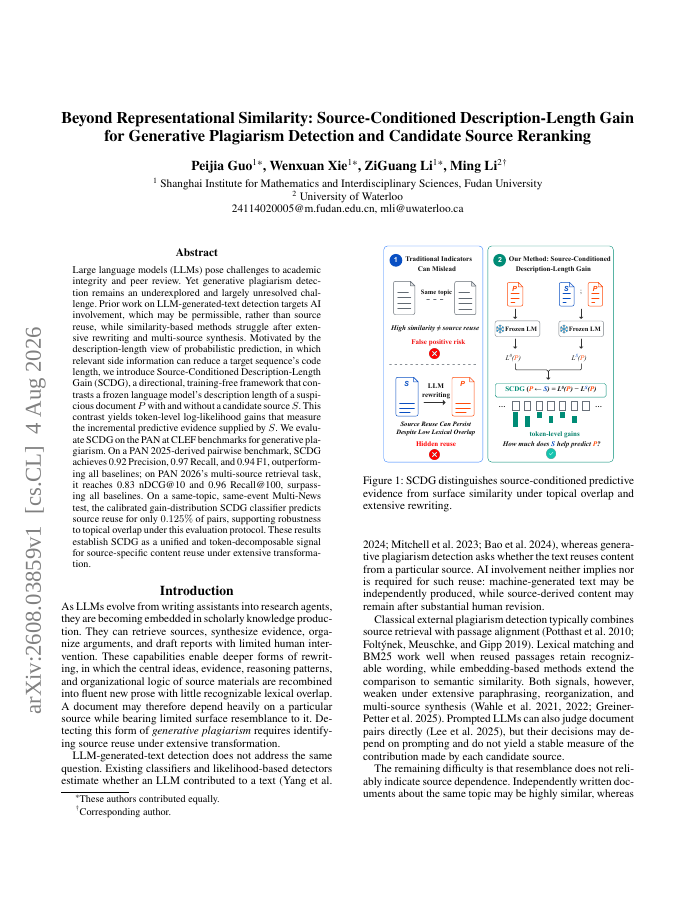
Large language models (LLMs) pose challenges to academic integrity and peer review. Yet generative plagiarism detection remains an underexplored and largely unresolved challenge. Prior work on LLM-generated-text detection targets AI involvement, which may be permissible, rather than source reuse, while similarity-based methods struggle after extensive rewriting and multi-source synthesis. Motivated by the description-length view of probabilistic prediction, in which relevant side information can reduce a target sequence's code length, we introduce Source-Conditioned Description-Length Gain (SCDG), a directional, training-free framework that contrasts a frozen language model's description length of a suspicious document P with and without a candidate source S. This contrast yields token-level log-likelihood gains that measure the incremental predictive evidence supplied by S. We evaluate SCDG on the PAN at CLEF benchmarks for generative plagiarism. On a PAN 2025-derived pairwise benchmark, SCDG achieves 0.92 Precision, 0.97 Recall, and 0.94 F1, outperforming all baselines; on PAN 2026's multi-source retrieval task, it reaches 0.83 nDCG@10 and 0.96 Recall@100, surpassing all baselines. On a same-topic, same-event Multi-News test, the calibrated gain-distribution SCDG classifier predicts source reuse for only 0.125% of pairs, supporting robustness to topical overlap under this evaluation protocol. These results establish SCDG as a unified and token-decomposable signal for source-specific content reuse under extensive transformation.
Beyond Representational Similarity: Source-Conditioned Description-Length Gain for Generative Plagiarism Detection and Candidate Source Reranking
Large language models (LLMs) pose challenges to academic integrity and peer review. Yet generative plagiarism detection remains an underexplored and largely unresolved challenge.
- Preview
- Year
- 2026
- Hosting
- Abstract onlyARXIV-DEFAULT
Cite
Notes
Only stored in your browser.
Attribution
- Abstract & full text
- arxiv.org/abs/2608.03859ARXIV-DEFAULT
- TL;DR
- Semantic Scholar