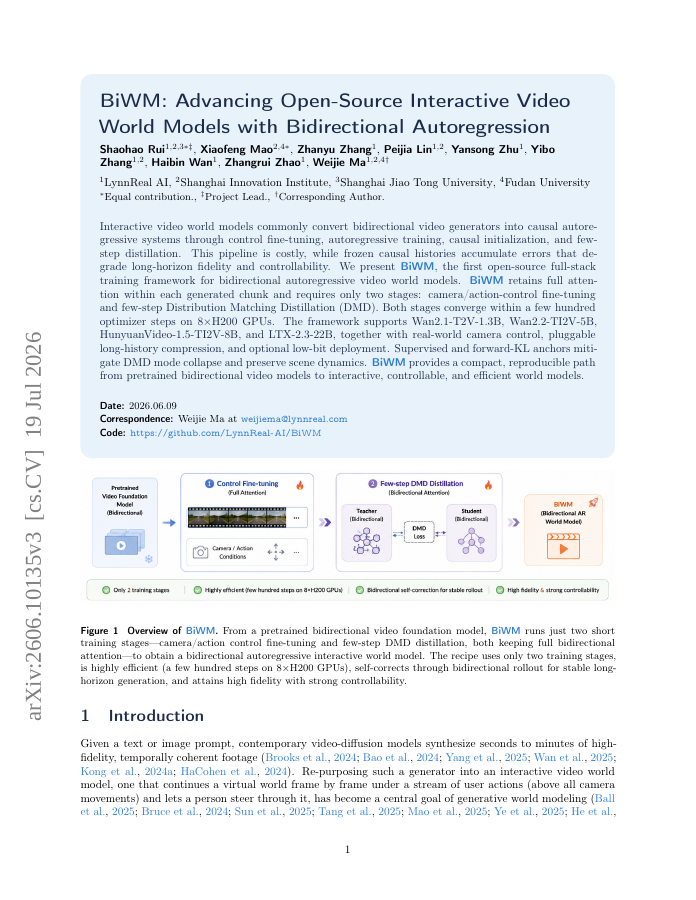
Interactive video world models commonly convert bidirectional video generators into causal autoregressive systems through control fine-tuning, autoregressive training, causal initialization, and few-step distillation. This pipeline is costly, while frozen causal histories accumulate errors that degrade long-horizon fidelity and controllability. We present BiWM, the first open-source full-stack training framework for bidirectional autoregressive video world models. BiWM retains full attention within each generated chunk and requires only two stages: camera/action-control fine-tuning and few-step Distribution Matching Distillation (DMD). Both stages converge within a few hundred optimizer steps on 8 H200 GPUs. The framework supports Wan2.1-T2V-1.3B, Wan2.2-TI2V-5B, HunyuanVideo-1.5-TI2V-8B, and LTX-2.3-22B, together with real-world camera control, pluggable long-history compression, and optional low-bit deployment. Supervised and forward-KL anchors mitigate DMD mode collapse and preserve scene dynamics. BiWM provides a compact, reproducible path from pretrained bidirectional video models to interactive, controllable, and efficient world models.
BiWM: Advancing Open-Source Interactive Video World Models with Bidirectional Autoregression
Interactive video world models commonly convert bidirectional video generators into causal autoregressive systems through control fine-tuning, autoregressive training, causal initialization, and few-step distillation.
- Preview
- Year
- 2026
- Hosting
- Abstract onlyARXIV-DEFAULT
Cite
Notes
Only stored in your browser.
Attribution
- Abstract & full text
- arxiv.org/abs/2606.10135ARXIV-DEFAULT
- TL;DR
- Semantic Scholar