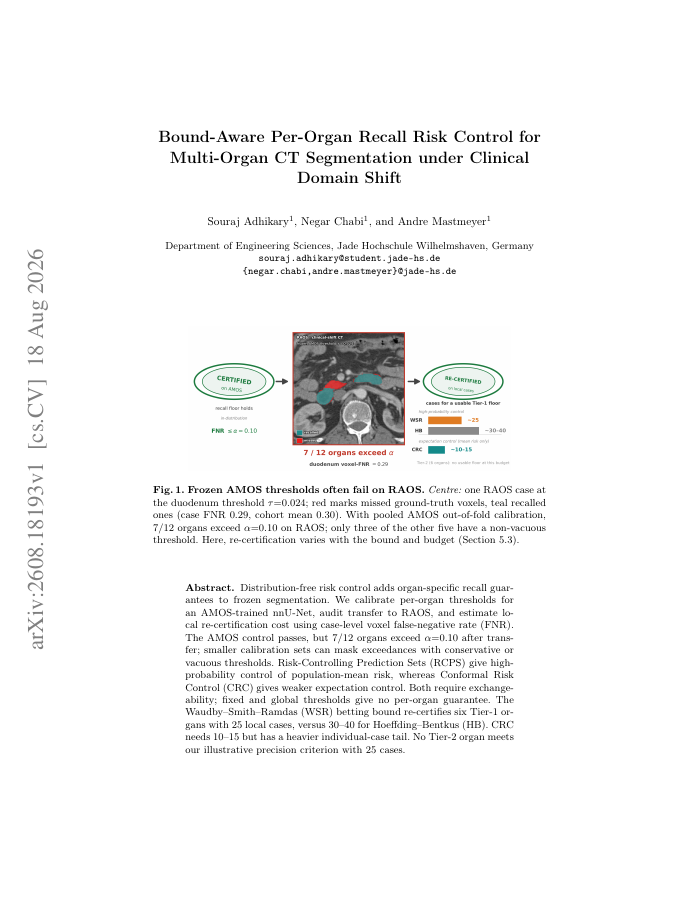
Distribution-free risk control adds organ-specific recall guarantees to frozen segmentation. We calibrate per-organ thresholds for an AMOS-trained nnU-Net, audit transfer to RAOS, and estimate local re-certification cost using case-level voxel false-negative rate (FNR). The AMOS control passes, but 7/12 organs exceed α{=}0.10 after transfer; smaller calibration sets can mask exceedances with conservative or vacuous thresholds. Risk-Controlling Prediction Sets (RCPS) give high-probability control of population-mean risk, whereas Conformal Risk Control (CRC) gives weaker expectation control. Both require exchangeability; fixed and global thresholds give no per-organ guarantee. The Waudby--Smith--Ramdas (WSR) betting bound re-certifies six Tier-1 organs with 25 local cases, versus 30--40 for Hoeffding--Bentkus (HB). CRC needs 10--15 but has a heavier individual-case tail. No Tier-2 organ meets our illustrative precision criterion with 25 cases.
Bound-Aware Per-Organ Recall Risk Control for Multi-Organ CT Segmentation under Clinical Domain Shift
Distribution-free risk control adds organ-specific recall guarantees to frozen segmentation. We calibrate per-organ thresholds for an AMOS-trained nnU-Net, audit transfer to RAOS, and estimate local re-certification cost using case-level voxel false-negative rate (FNR).
- Preview
- Year
- 2026
- Hosting
- Abstract onlyARXIV-DEFAULT
Cite
Notes
Only stored in your browser.
Attribution
- Abstract & full text
- arxiv.org/abs/2608.18193ARXIV-DEFAULT
- TL;DR
- Semantic Scholar