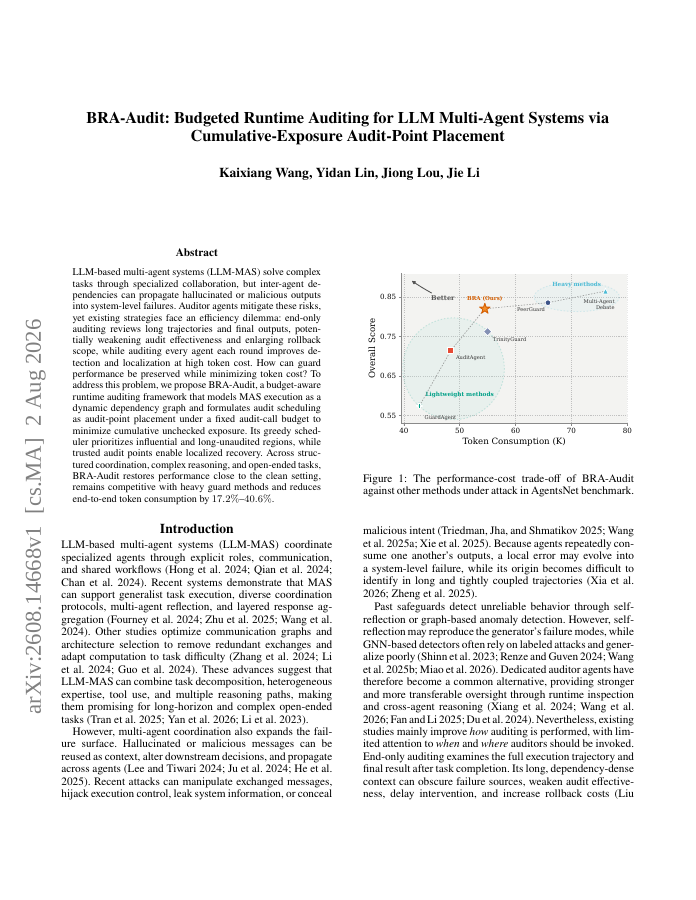
LLM-based multi-agent systems (LLM-MAS) solve complex tasks through specialized collaboration, but inter-agent dependencies can propagate hallucinated or malicious outputs into system-level failures. Auditor agents mitigate these risks, yet existing strategies face an efficiency dilemma: end-only auditing reviews long trajectories and final outputs, potentially weakening audit effectiveness and enlarging rollback scope, while auditing every agent each round improves detection and localization at high token cost. How can guard performance be preserved while minimizing token cost? To address this problem, we propose BRA-Audit, a budget-aware runtime auditing framework that models MAS execution as a dynamic dependency graph and formulates audit scheduling as audit-point placement under a fixed audit-call budget to minimize cumulative unchecked exposure. Its greedy scheduler prioritizes influential and long-unaudited regions, while trusted audit points enable localized recovery. Across structured coordination, complex reasoning, and open-ended tasks, BRA-Audit restores performance close to the clean setting, remains competitive with heavy guard methods and reduces end-to-end token consumption by 17.2%--40.6%.
BRA-Audit: Budgeted Runtime Auditing for LLM Multi-Agent Systems via Cumulative-Exposure Audit-Point Placement
LLM-based multi-agent systems (LLM-MAS) solve complex tasks through specialized collaboration, but inter-agent dependencies can propagate hallucinated or malicious outputs into system-level failures.
- Preview
- Year
- 2026
- Hosting
- Full text hostedCC-BY-4.0
Cite
Notes
Only stored in your browser.
Attribution
- Abstract & full text
- arxiv.org/abs/2608.14668CC-BY-4.0
- TL;DR
- Semantic Scholar