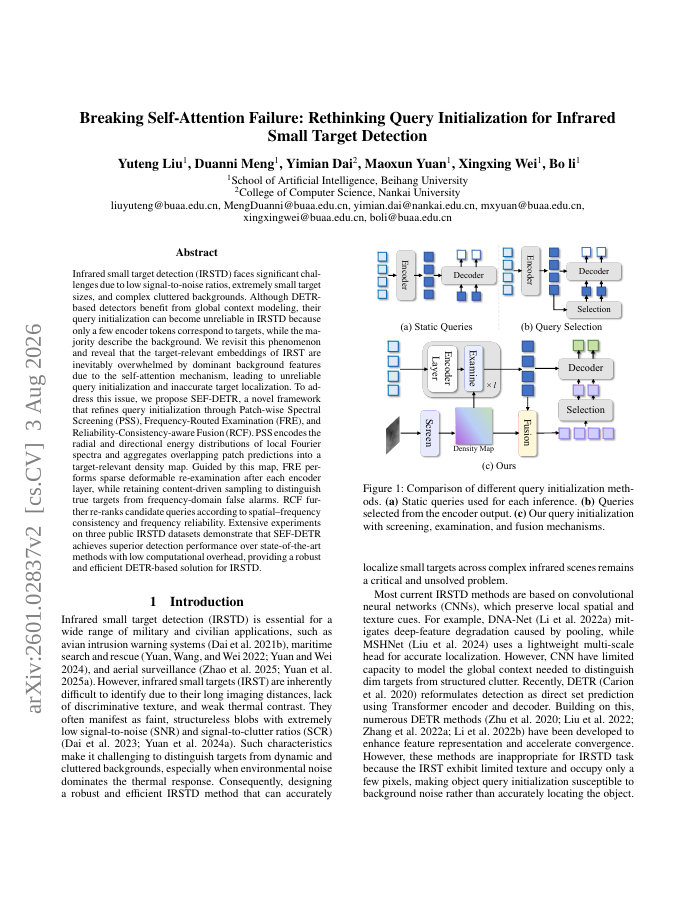
Infrared small target detection (IRSTD) faces significant challenges due to low signal-to-noise ratios, extremely small target sizes, and complex cluttered backgrounds. Although DETR-based detectors benefit from global context modeling, their query initialization can become unreliable in IRSTD because only a few encoder tokens correspond to targets, while the majority describe the background. We revisit this phenomenon and reveal that the target-relevant embeddings of IRST are inevitably overwhelmed by dominant background features due to the self-attention mechanism, leading to unreliable query initialization and inaccurate target localization. To address this issue, we propose SEF-DETR, a novel framework that refines query initialization through Patch-wise Spectral Screening (PSS), Frequency-Routed Examination (FRE), and Reliability-Consistency-aware Fusion (RCF). PSS encodes the radial and directional energy distributions of local Fourier spectra and aggregates overlapping patch predictions into a target-relevant density map. Guided by this map, FRE performs sparse deformable re-examination after each encoder layer, while retaining content-driven sampling to distinguish true targets from frequency-domain false alarms. RCF further re-ranks candidate queries according to spatial-frequency consistency and frequency reliability. Extensive experiments on three public IRSTD datasets demonstrate that SEF-DETR achieves superior detection performance over state-of-the-art methods with low computational overhead, providing a robust and efficient DETR-based solution for IRSTD.
Breaking Self-Attention Failure: Rethinking Query Initialization for Infrared Small Target Detection
Infrared small target detection (IRSTD) faces significant challenges due to low signal-to-noise ratios, extremely small target sizes, and complex cluttered backgrounds. Although DETR-based detectors benefit from global context modeling, their query initialization can become…
- Preview
- Year
- 2026
- Hosting
- Abstract onlyARXIV-DEFAULT
Cite
Notes
Only stored in your browser.
Attribution
- Abstract & full text
- arxiv.org/abs/2601.02837ARXIV-DEFAULT
- TL;DR
- Semantic Scholar