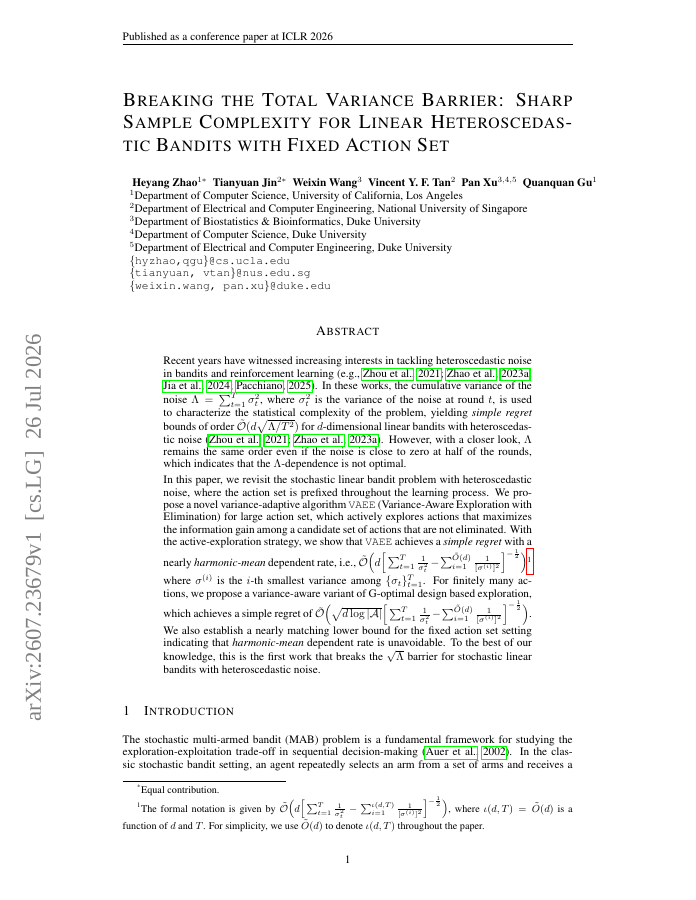
Recent years have witnessed increasing interests in tackling heteroscedastic noise in bandits and reinforcement learning. In these works, the cumulative variance of the noise Λ= \sum_{t=1}^T σ_t^2, where σ_t^2 is the variance of the noise at round t, is used to characterize the statistical complexity of the problem, yielding simple regret bounds of order \tilde{\cal{O}}(d \sqrt{Λ/ T^2}) for d-dimensional linear bandits with heteroscedastic noise. However, with a closer look, Λ remains the same order even if the noise is close to zero at half of the rounds, which indicates that the Λ-dependence is not optimal. In this paper, we revisit the stochastic linear bandit problem with heteroscedastic noise, where the action set is prefixed throughout the learning process. We propose a novel variance-adaptive algorithm VAEE (Variance-Aware Exploration with Elimination) for large action set, which actively explores actions that maximizes the information gain among a candidate set of actions that are not eliminated. With the active-exploration strategy, we show that VAEE achieves a simple regret with a nearly harmonic-mean dependent rate. For finitely many actions, we propose a variance-aware variant of G-optimal design based exploration, which achieves a simple regret with sharper dependence on d. We also establish a nearly matching lower bound for the fixed action set setting indicating that harmonic-mean dependent rate is unavoidable. To the best of our knowledge, this is the first work that breaks the \sqrtΛ barrier for stochastic linear bandits with heteroscedastic noise.
Breaking the Total Variance Barrier: Sharp Sample Complexity for Linear Heteroscedastic Bandits with Fixed Action Set
Recent years have witnessed increasing interests in tackling heteroscedastic noise in bandits and reinforcement learning. In these works, the cumulative variance of the noise $Λ= \sum_{t=1}^T σ_t^2$, where $σ_t^2$ is the variance of the noise at round $t$, is used to…
- Preview
- Year
- 2026
- Hosting
- Abstract onlyARXIV-DEFAULT
Cite
Notes
Only stored in your browser.
Attribution
- Abstract & full text
- arxiv.org/abs/2607.23679ARXIV-DEFAULT
- TL;DR
- Semantic Scholar