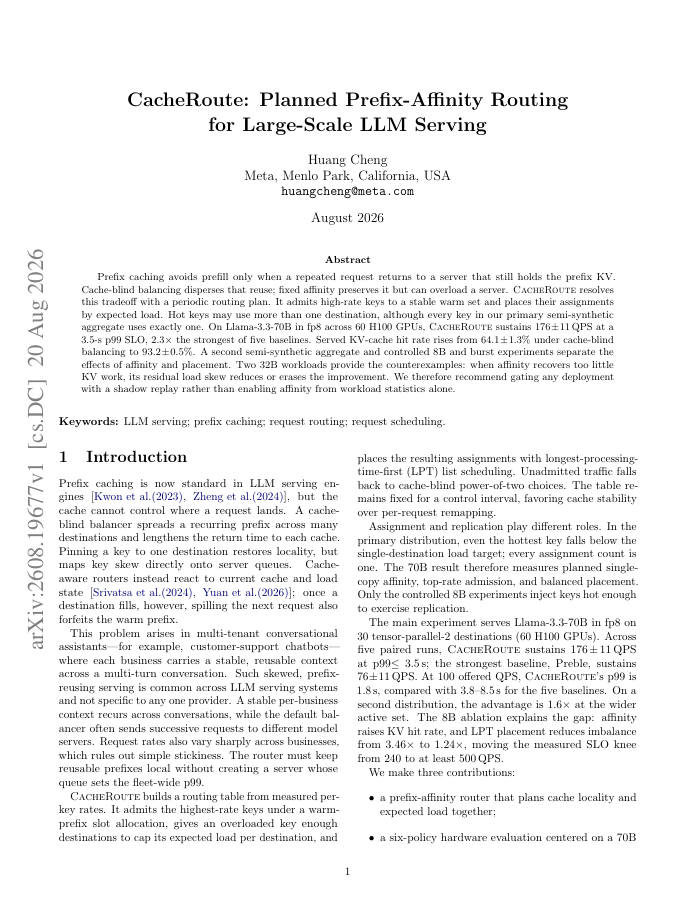
Prefix caching avoids prefill only when a repeated request returns to a server that still holds the prefix KV. Cache-blind balancing disperses that reuse; fixed affinity preserves it but can overload a server. CacheRoute resolves this tradeoff with a periodic routing plan. It admits high-rate keys to a stable warm set and places their assignments by expected load. Hot keys may use more than one destination, although every key in our primary semi-synthetic aggregate uses exactly one. On Llama-3.3-70B in fp8 across 60 H100 GPUs, CacheRoute sustains 176+/-11 QPS at a 3.5-s p99 SLO, 2.3x the strongest of five baselines. Served KV-cache hit rate rises from 64.1+/-1.3% under cache-blind balancing to 93.2+/-0.5%. A second semi-synthetic aggregate and controlled 8B and burst experiments separate the effects of affinity and placement. Two 32B workloads provide the counterexamples: when affinity recovers too little KV work, its residual load skew reduces or erases the improvement. We therefore recommend gating any deployment with a shadow replay rather than enabling affinity from workload statistics alone.
CacheRoute: Planned Prefix-Affinity Routing for Large-Scale LLM Serving
Prefix caching avoids prefill only when a repeated request returns to a server that still holds the prefix KV. Cache-blind balancing disperses that reuse; fixed affinity preserves it but can overload a server. CacheRoute resolves this tradeoff with a periodic routing plan.
- Preview
- Year
- 2026
- Hosting
- Abstract onlyARXIV-DEFAULT
Cite
Notes
Only stored in your browser.
Attribution
- Abstract & full text
- arxiv.org/abs/2608.19677ARXIV-DEFAULT
- TL;DR
- Semantic Scholar