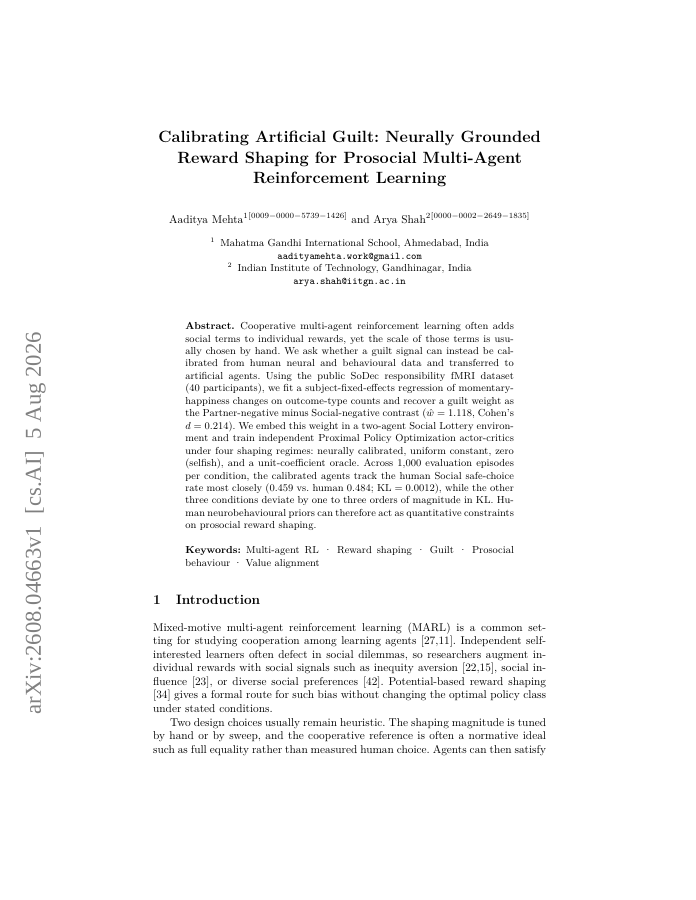
Cooperative multi-agent reinforcement learning often adds social terms to individual rewards, yet the scale of those terms is usually chosen by hand. We ask whether a guilt signal can instead be calibrated from human neural and behavioural data and transferred to artificial agents. Using the public SoDec responsibility fMRI dataset (40 participants), we fit a subject-fixed-effects regression of momentary-happiness changes on outcome-type counts and recover a guilt weight as the Partner-negative minus Social-negative contrast (\hat{w}=1.118, Cohen's d=0.214). We embed this weight in a two-agent Social Lottery environment and train independent Proximal Policy Optimization actor-critics under four shaping regimes: neurally calibrated, uniform constant, zero (selfish), and a unit-coefficient oracle. Across 1{,}000 evaluation episodes per condition, the calibrated agents track the human Social safe-choice rate most closely (0.459 vs.\ human 0.484; KL=0.0012), while the other three conditions deviate by one to three orders of magnitude in KL. Human neurobehavioural priors can therefore act as quantitative constraints on prosocial reward shaping.
Calibrating Artificial Guilt: Neurally Grounded Reward Shaping for Prosocial Multi-Agent Reinforcement Learning
Cooperative multi-agent reinforcement learning often adds social terms to individual rewards, yet the scale of those terms is usually chosen by hand. We ask whether a guilt signal can instead be calibrated from human neural and behavioural data and transferred to artificial…
- Preview
- Year
- 2026
- Hosting
- Full text hostedCC-BY-4.0
Cite
Notes
Only stored in your browser.
Attribution
- Abstract & full text
- arxiv.org/abs/2608.04663CC-BY-4.0
- TL;DR
- Semantic Scholar