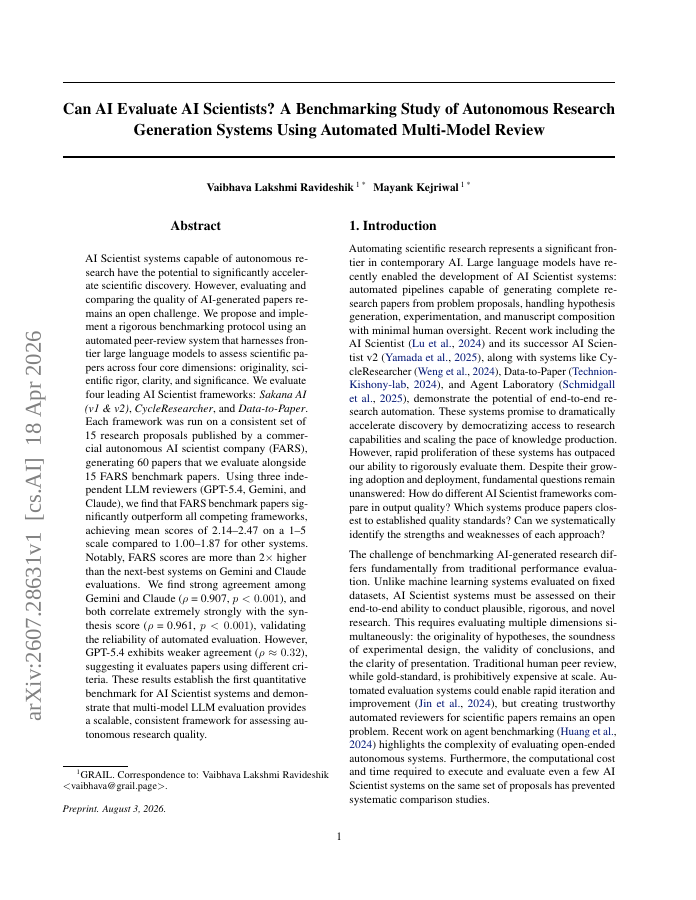
AI Scientist systems capable of autonomous research have the potential to significantly accelerate scientific discovery. However, evaluating and comparing the quality of AI-generated papers remains an open challenge. We propose and implement a rigorous benchmarking protocol using an automated peer-review system that harnesses frontier large language models to assess scientific papers across four core dimensions: originality, scientific rigor, clarity, and significance. We evaluate four leading AI Scientist frameworks: Sakana AI (v1 & v2), CycleResearcher, and Data-to-Paper. Each framework was run on a consistent set of 15 research proposals published by a commercial autonomous AI scientist company (FARS), generating 60 papers that we evaluate alongside 15 FARS benchmark papers. Using three independent LLM reviewers (GPT-5.4, Gemini, and Claude), we find that FARS benchmark papers significantly outperform all competing frameworks, achieving mean scores of 2.14--2.47 on a 1--5 scale compared to 1.00--1.87 for other systems. Notably, FARS scores are more than 2\times higher than the next-best systems on Gemini and Claude evaluations. We find strong agreement among Gemini and Claude (ρ = 0.907, p < 0.001), and both correlate extremely strongly with the synthesis score (ρ = 0.961, p < 0.001), validating the reliability of automated evaluation. However, GPT-5.4 exhibits weaker agreement (ρ\approx 0.32), suggesting it evaluates papers using different criteria. These results establish the first quantitative benchmark for AI Scientist systems and demonstrate that multi-model LLM evaluation provides a scalable, consistent framework for assessing autonomous research quality.
Can AI Evaluate AI Scientists? A Benchmarking Study of Autonomous Research Generation Systems Using Automated Multi-Model Review
AI Scientist systems capable of autonomous research have the potential to significantly accelerate scientific discovery. However, evaluating and comparing the quality of AI-generated papers remains an open challenge.
- Preview
- Year
- 2026
- Hosting
- Full text hostedCC-BY-4.0
Cite
Notes
Only stored in your browser.
Attribution
- Abstract & full text
- arxiv.org/abs/2607.28631CC-BY-4.0
- TL;DR
- Semantic Scholar