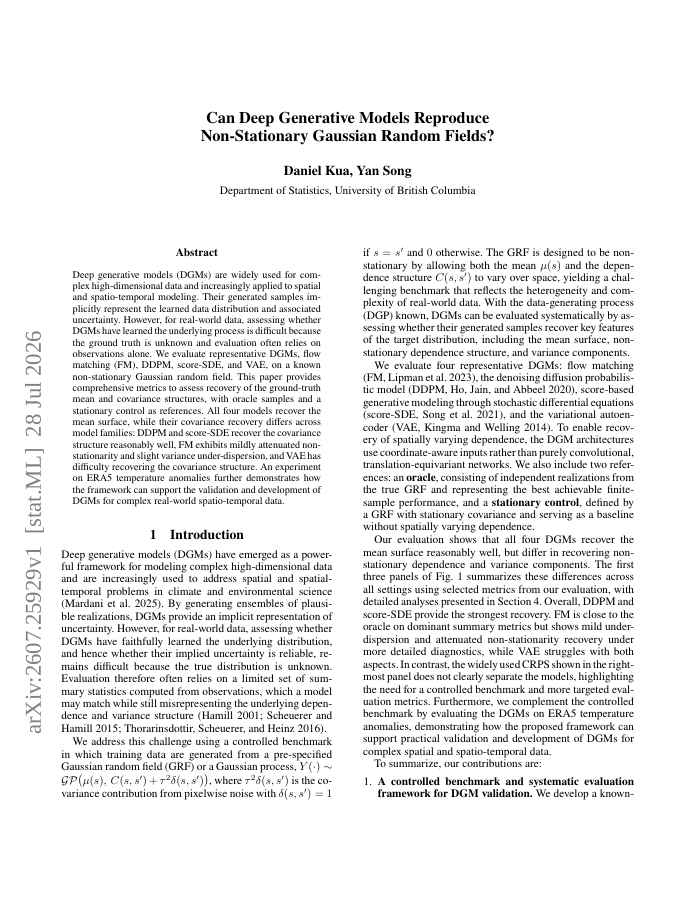
Deep generative models (DGMs) are widely used for complex high-dimensional data and increasingly applied to spatial and spatio-temporal modeling. Their generated samples implicitly represent the learned data distribution and associated uncertainty. However, for real-world data, assessing whether DGMs have learned the underlying process is difficult because the ground truth is unknown and evaluation often relies on observations alone. We evaluate representative DGMs, flow matching (FM), DDPM, score-SDE, and VAE, on a known non-stationary Gaussian random field. This paper provides comprehensive metrics to assess recovery of the ground-truth mean and covariance structures, with oracle samples and a stationary control as references. All four models recover the mean surface, while their covariance recovery differs across model families: DDPM and score-SDE recover the covariance structure reasonably well, FM exhibits mildly attenuated non-stationarity and slight variance under-dispersion, and VAE has difficulty recovering the covariance structure. An experiment on ERA5 temperature anomalies further demonstrates how the framework can support the validation and development of DGMs for complex real-world spatio-temporal data.
Can Deep Generative Models Reproduce Non-Stationary Gaussian Random Fields?
Deep generative models (DGMs) are widely used for complex high-dimensional data and increasingly applied to spatial and spatio-temporal modeling. Their generated samples implicitly represent the learned data distribution and associated uncertainty.
- Preview
- Year
- 2026
- Hosting
- Abstract onlyARXIV-DEFAULT
Cite
Notes
Only stored in your browser.
Attribution
- Abstract & full text
- arxiv.org/abs/2607.25929ARXIV-DEFAULT
- TL;DR
- Semantic Scholar