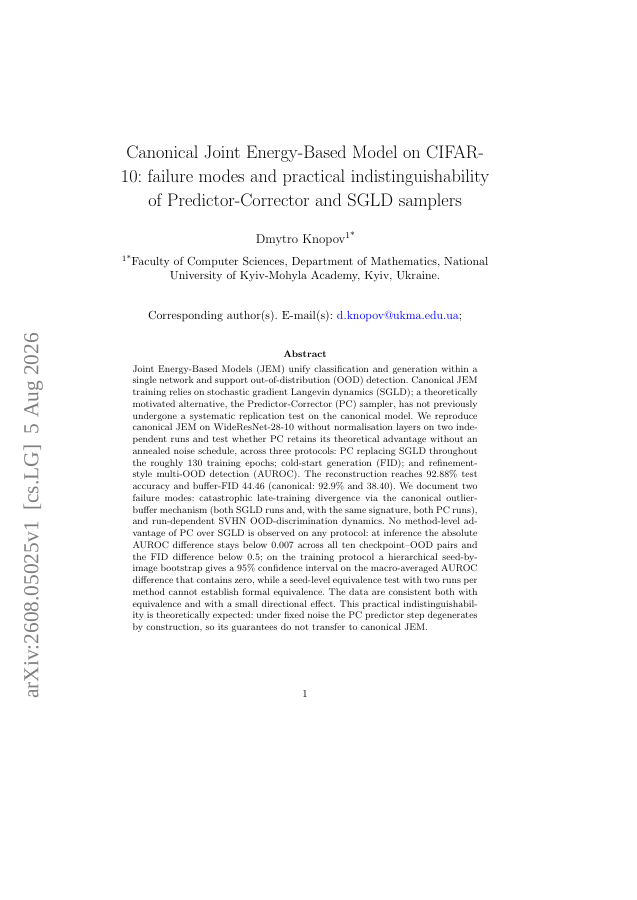
Joint Energy-Based Models (JEM) unify classification and generation within a single network and support out-of-distribution (OOD) detection. Canonical JEM training relies on stochastic gradient Langevin dynamics (SGLD); a theoretically motivated alternative, the Predictor-Corrector (PC) sampler, has not previously undergone a systematic replication test on the canonical model. We reproduce canonical JEM on WideResNet-28-10 without normalisation layers on two independent runs and test a fixed-noise PC adaptation - with the degenerate annealed-noise predictor replaced by a deterministic gradient step - across three protocols: the adapted sampler replacing SGLD throughout the full training trajectories (115-132 epochs); cold-start generation (FID); and refinement-style multi-OOD detection (AUROC). The reconstruction reaches 92.88% test accuracy and buffer-FID 44.46 (canonical: 92.9% and 38.40). We document two failure modes: catastrophic late-training divergence with the signature of the canonical outlier-buffer mechanism (all four runs), and run-dependent SVHN OOD-discrimination dynamics. No consistent method-level advantage of the adaptation over SGLD is observed on any protocol: refinement AUROC differences stay below 0.007 across ten checkpoint-OOD pairs; seeded cold-start generation favours SGLD by about five FID points; on the training protocol a hierarchical seed-by-image bootstrap gives a 95% confidence interval on the macro-averaged AUROC difference that contains zero, while a seed-level equivalence test with two runs per method cannot establish formal equivalence. The training-protocol data are consistent both with equivalence and with a small directional effect. This outcome is consistent with theory: the guarantees of the annealed-noise PC framework do not transfer to the constant-noise regime of canonical JEM.
Comparing SGLD and a fixed-noise Predictor-Corrector adaptation in canonical Joint Energy-Based Models on CIFAR-10
Joint Energy-Based Models (JEM) unify classification and generation within a single network and support out-of-distribution (OOD) detection. Canonical JEM training relies on stochastic gradient Langevin dynamics (SGLD); a theoretically motivated alternative, the…
- Preview
- Year
- 2026
- Hosting
- Abstract onlyARXIV-DEFAULT
Cite
Notes
Only stored in your browser.
Attribution
- Abstract & full text
- arxiv.org/abs/2608.05025ARXIV-DEFAULT
- TL;DR
- Semantic Scholar